



Should you believe in something that’s beenover-hyped, over-promoted, and over-blown? In the case of design thinking, yes,you should. Like an overused cliché that still rings true, design thinking maybe exaggerated as the cure-all for the uninspired, but it is too valuable amethod to toss aside. Here, I will address some of common criticism of designthinking.
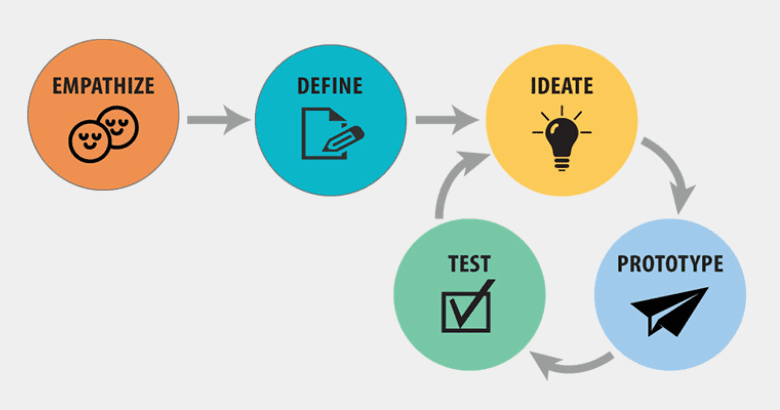
In case you came late to the party, designthinking is both a mindset and a methodology for generating creative solutions.It’s not magic, and it’s not a silver bullet. Yet there are certaincharacteristics of design thinking that make it effective in almost any field,from business innovation to product design to learning design. Design thinkingis iterative, human-centered and flexible. One of the original approaches todesign thinking consists of five phases:
- Empathize with theuser
- Define the problem
- Ideate solutions
- Prototype solutions
- Test and refine thesolutions
You will find the process described in varied phases andrepresented in different diagrams, but the general principles are the same.
Figure 1: Thefive phases of the design thinking approach
Why design thinking is effective
Design thinking is effective because itrequires multidisciplinary teams. This mix of unique and varied perspectivescreates the spark that can lead to innovative thinking. Design thinking demandsthat you understand the audience or user at a very deep level by observing andgetting to know them (the Empathize phase). It prods you to get at the rootcause rather than the superficial aspect of a problem (the Define phase). Itsupports divergent thinking, so that teams can generate a wide range ofsolutions (the Ideate phase). And it supports convergent thinking fororganizing and selecting viable solutions from the wealth of ideas.
Design thinking involves building low-fidelityprototypes (the Prototype phase) to let users try out your team’s ideas (theTest phase). Members of the target audience may even co-design with you. Thisiterative process continues as you filter out the less effective ideas andrefine the worthwhile ones.
Criticisms of design thinking
After design thinking was widelypopularized as the ultimate way totransform business, technology, management, products, services, and education,it was bound to inspire criticism. The number of articles and books praisingdesign thinking only added to the rebellion. While many of the criticisms arevalid, design thinking could still work in your organization. Let’s examineeach complaint and find a way to overcome it.
The Criticism: Designthinking is ill-defined
The flexibility of design thinking is botha benefit and a curse. Although design thinking methods can be applied toproblems of all magnitudes and in all fields, its adaptability has led tovaried definitions and interpretations. This confuses those who want to try itout but don’t know which path to take.
The Cure
Within each definition and methodology,look to the spirit of design thinking. It will reflect the fine principles ofinspired human-centered design. Find a method that speaks to the world youinhabit. It shouldn’t take long to find the one that’s right for your team. Asa design thinking enthusiast, I am most interested in the essence of themethod.
The Criticism: Design thinking istoo process-oriented
Critics contend that many organizations areoverly focused on the process, resulting in a rigid system that fails toproduce innovative ideas. In their effort to quickly seek transformation, theseorganizations try to turn creativity into an efficient process. There isnothing efficient about creativity or design.
The Cure:
To avoid a focus on process alone, develop amindset and environment that are conducive to design thinking.
- Instill optimism,empathy, and inspiration into your design thinking sessions.
- Promote a designthinking culture that allows for messy exploration, ambiguity, and failure.
- Dig deeply for yourmost creative ideas. Go beyond the superficial solutions.
The Criticism: Design thinking isnot how real designers work
Some professional designers claim thatdesign thinking does not reflect their technique. One specific aspect that ismissing is the design critique. Critiques are a common practice in designstudios and in some learning experience design departments. They are a valuablepart of the feedback loop that designers need from other professionals.
The Cure:
Consider adding design critiques to yourdesign thinking process or as part of your workflow. Learn more about the benefitsof the critique process, how to run a critique, and how they can help designersreach their goals. Then incorporate design critiques into your practice.
The Criticism: Brainstorming doesn’t work
Critics complain that brainstorming,conducted during the ideation phase, is not effective for creative thinking andmay leave the shy among us lurking in the background. These critics don’trealize that there are many ways to generate ideas that don’t involvetraditional brainstorming.
The Cure:
One approach is to conduct brainstormingsessions where ideas are written rather than expressed verbally. Using thisapproach, participants are presented with the problem statement or with “HowMight We” questions. They then write their solutions on sticky notes that theyplace on a vertical surface to be organized and discussed at the end. Witheveryone involved in the physical act of writing and placing sticky notes on awall, no one person has the hot seat.
There are many other approaches to ideageneration, such as providing time for making rudimentary sketches or time forindividual brainstorming. Finally, an approach that some teams might like is towrite ideas on paper and then pass the paper on to the next person, who buildson the idea. In a few minutes, pass the paper again. At the end, hang thepapers so everyone can read them and discuss.
The Criticism: Design Thinking Can Never Replace _____ (fillin the blank)
Practitioners in many fields are concernedthat design thinking will replace their traditional methodologies. Our field isno different. There are concerns that design thinking will replaceinstructional design.
The Cure:Instructional design and design thinking are not parallel methodologies, sothis should not be a concern. Use design thinking to enrich your instructionaldesign practice, not replace it. Allow the tools of design thinking totransform your mindset, so that you make design choices based on empathy. Letdesign thinking deepen your analysis, so that you examine the underlyingproblem—not the superficial one. Use design thinking methods to find creativeways to approach training and to guide your cycles of prototyping and testing.But ensure that you are still grounded in solutions that are based oninstructional science.
The positive side of criticism
Regardless of the method or model youchoose, every potential solution in our work involves the conception of ideasand the implementation of a vision. We now have an opportunity to integratedesign thinking with learning experience design. If we look squarely at thevalid criticism of design thinking, we can help the method evolve into animproved strategy that increases creative and imaginative thinking. This isimperative to building the design-centric culture we require to do our jobs theright way. John Kolko, vice president of design at Blackboard, writes, “Adesign-centric culture transcends design as a role, imparting a set ofprinciples to all people who help bring ideas to life.”
Want to Learn More?
ConnieMalamed will present a pre-conference workshop, Using Design Thinking to Craft Learning Experiences, onMarch 25 at Learning Solutions 2018 Conference & Expo in Orlando, Florida.

