There’s a lot of talk these daysabout informal learning vs. formal learning. Everyone knows that thevast majority of learning in the workplace is informal, but not somany know what to do about it.
To fill this void, I advocate thedevelopment of an Informal Learning Environment (ILE) to work intandem with a Formal Learning Environment (FLE) to support both thelearning process and its administration.
Allow me to explain by illustrating howit might be implemented in a real organization.
Informal learning
I believe in the power of informallearning. In fact, I go so far as to say it should be the centralphilosophy of an organization’s learning model. In a practicalsense, that means we need to provide our learners with tools andresources that they can use to drive their own development.
This is where the ILE fits in: It’s aspace (like a Web site or intranet site) that centralizes those toolsand resources.
The ILE illustrated
There are a thousand and one possiblecombinations and permutations of an ILE. However, if I were toconsider a greenfield opportunity, that is, a situation that wascompletely open, what would I design?
Essentially I would base my design onthree core components, as illustrated in Figure 1.
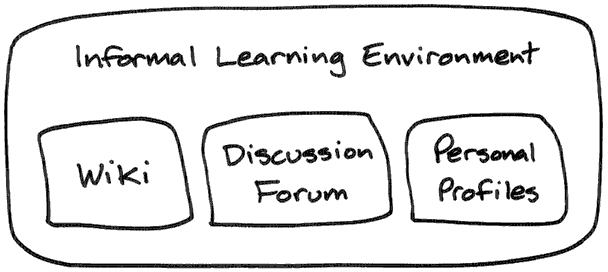
Figure 1. The three core components of an Informal Learning Environment design
Core component #1: Wiki
The primary component of my ILE is acomprehensive wiki.
In a big corporation like the one Iwork for, knowledge is distributed everywhere – on obscure intranetpages, in random folders, in people’s heads – which makes itreally hard to find.
A wiki enables the organization tocentralize that collateral, whether directly (by inputting it) orindirectly (by linking to where it exists elsewhere), therebyfunctioning as the first port of call.
A wiki can contain – or point to –all manner of media, such as text, graphics, documents, andmultimedia. Learners can search and explore the content that’srelevant to them, just-in-time if need be.
The flexibility of a wiki also allowsanyone to contribute content. This empowers the learner to sharetheir knowledge with their colleagues, build on the knowledge thathas already been contributed by others, and communally keep it up todate.
Core component #2: Discussion forum
The secondary component of my ILE is anopen discussion forum. I say “secondary” because my rationale isthat, if the learner can’t find the knowledge they need in thewiki, they can crowdsource it via the forum.
A discussion forum enables the learnerto post a question to peers, thereby leveraging the collectiveintelligence of the organization. Of course, the learner can alsoshare knowledge by answering someone else’s question, and thelearner can learn incidentally by reading the questions and answersof others.
The questions posted to the forum mayalso serve to expose knowledge deficiencies in the organization,which you can remedy by updating the wiki!
Core component #3: Personal profiles
The tertiary component of my ILE is abank of personal profiles. I say “tertiary” because I believethat, if the learner can’t find the needed knowledge in the wikinor via the discussion forum, he or she can target a subject matterexpert (SME) directly.
For example, if the learner isstruggling with a Java programming problem, he or she can look up aJava expert in the system and send them a direct message. The SME maybe recognized as a “Java” SME because they have said so in theirprofile, or – if the technology is sophisticated enough – theircontributions of Java-related content in the wiki and participationin Java-related conversations on the discussion forum flag them assuch.
Side note: I’m in two minds as towhether a full-blown social network is useful for internal learningpurposes. Apart from profiling, I’m not convinced that friending,status updating, and other Facebook-like activities add much value –especially when a discussion forum that accommodates groups isalready in place.
Formal learning
Self-directed, informal learning isgreat. However, there are some things your employer must know thatyou know.
The most obvious example is compliance,e.g. privacy, trade practices, and Occupational Health & Safety(OH&S). If you breach the regulations, the company will be in hotwater, so they’re not just going to take your word for it.
There are plenty of other examples,such as a certain level of product knowledge that may be critical tothe role.
In a practical sense, this means weshould map required competencies to each role and assess theemployee’s proficiency against each one. That probably leads to adevelopment plan, which in turn forms a subset of the performanceagreement and is subject to regular appraisals.
Then there are formal training eventslike courses and workshops that are important and requiredocumentation, and some people want their informal learning (e.g.,reading a book) recorded too.
The FLE is a space (like a database orplatform) in which all this administration is done.
The FLE illustrated
Again, there are a thousand and onepossible combinations and permutations of a FLE. However I base mydesign on two core components, as Figure 2 illustrates.

Figure 2. The Formal Learning Environment has two core components.
Core component #1: Learning ManagementSystem
The primary component of my FLE is aLearning Management System (LMS).
The LMS is an oft-derided yetinvaluable educational technology. I suspect the typical organizationunder-appreciates it because it uses it illogically.
My advice is to use the LMS for whatit’s designed for: managing learning. Competency maps, auto-markedassessments, registrations, completion statuses, grades, transcripts,performance agreements, and performance appraisals are what the LMSdoes well. Some even extend into talent management and other HRdomains.
Conversely, my advice is to avoid usingthe LMS for what it is not really designed for: managing content.Leave that to the ILE, which is a much more open and flexibleenvironment, and is purpose-built to support “learning.”
Core component #2: Reports
The complementary component of my FLEis the range of reports that various systems can generate to provideuseful data. Such data may include productivity statistics, qualityscores, complaint volumes, engagement indices … whatever we cananalyze to identify training needs and/orevaluate learning outcomes.
At the end of the day, learning mustsupport performance.
Putting it all together
My revamped learning model (Figure 3),then, comprises two discrete but related virtual environments:
- An Informal Learning Environment,and
- A Formal Learning Environment.
The former supports the process oflearning; the latter supports its management.

Figure 3. The revamped learning model supports learning and its management.
Separating the two environments likethis aids in segregating them in the human mind.
Why bother? Because learning should bea joy.
By definition, an ILE should beunforced, unscored, unthreatening. It should be a safe, open spacewhere people are excited to go because they want to learn, withoutthe burden of forced navigation and pass/fail marks.
Simultaneously, a FLE should focus onwhat really matters. Too often, when formal and informal learning aremixed, goals blur and we run the risk of formalizing forformalizing’s sake. We don’t need to monitor our colleagues likeBig Brother; we just need to assess them when necessary.
Closing: How long is a piece ofstring?
Of course, many more components may bereasonably argued for inclusion in the learning model.
An onsite classroom, for example, isobviously a part of the formal learning environment. So too is auniversity campus on the other side of town. In terms of informallearning, the water cooler, a cabinet of books – and even the pagesin a book – may be considered components of the ILE.
How about a library of online courses?That might be considered a component of the ILE if the learner isfree to explore it at their convenience, but it will suddenly revertto the FLE if the learner is instructed to complete a particularcourse.
Clearly then, the ILE and the FLE areelastic concepts, highly dependent on perspective and context. That’swhy I have focused on the core components that I think can provide auniversal framework for a revamped learning model.
The two virtual environments areconstant; everything else around them is variable.