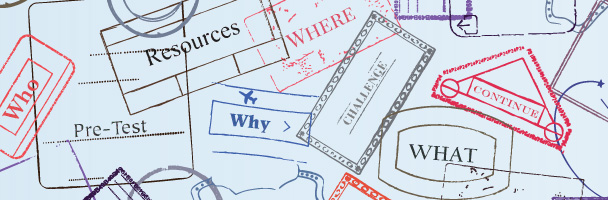
A design-development team from Booz Allen Hamilton and Cinécraft Productions has achieved the holy grailof eLearning: training on dense, complex, information-laden topics that is acclaimedby learners. This article explores two of their projects: a required ethics andcompliance training course that got rave reviews from learners, and a DemoFestBest of Show–winning microlearning project on government contract regulations.A companion article will share their winning strategies and tips.
Liz Gusmati is a lead associate at Booz Allen Hamilton,where she designs finance and business development eLearning and training. DanKeckan, vice president of eLearning and instructional design at Cinécraft,leads a team of instructional and graphic designers and eLearning developers.They joined forces with members of Booz Allen Hamilton’s ethics and compliance teamto create engaging eLearning on topics that, to an untrained ear, soundanything but engaging.
Compliance training takes learners on a journey
Gusmati needed an ethics and compliance course oninternational trade regulations for employees based outside the United Statesor working with clients outside the United States. It is a mandatory coursewith content that she describes as “very dense and dry,” but also critical. “Ifyou’re not aware of certain laws and regulations, then it makes it harder toact ethically,” she said. People need to know what to do and where to turn forhelp—informationthat is provided in the course and as downloadable references.
The course, an eLearning course that can be completed inabout 30 minutes, is based on a travel theme, and learners receive “stamps” ina virtual “passport” as they complete sections. The sections build on oneanother, so learners get basic information first, then work through scenarioswhere they apply what they’ve learned.
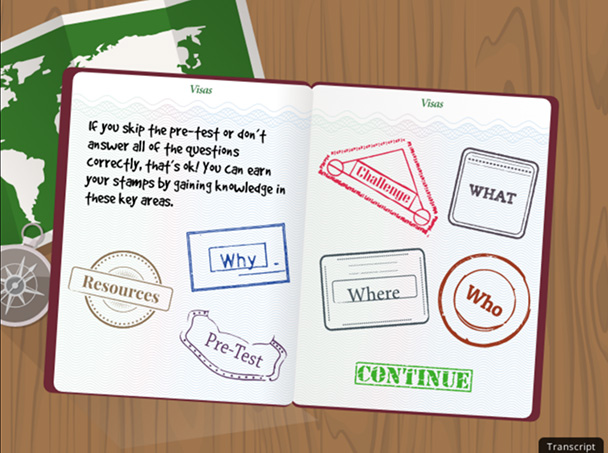
Figure 1: Learners receive“stamps” in a virtual “passport” as they complete sections of the ethics andcompliance training course
The team used Storyline 2 to create the course but paidspecial attention to the design. “One of our goals was to make it not feel likethe learner was taking a training course,” Gusmati said. “We want them to feellike they’re inside an experience, like you would in a video game.” Toaccomplish that, the team got rid of Storyline’s standard navigation andtemplate elements, “making Storyline work for us, not the other way around.”
Gusmati said the course was easy to design and implement.While the team wanted to keep it simple, they wanted to include “lots of eyecandy and enough sound effects to bring the course to life,” Gusmati said. “Firstwe looked at how to chunk the information; once we chunked it down, we thought,‘How can we introduce game elements and make it fun?’”
Keckan’s team handled the development, including aesthetics.Gusmati credits them with some of the fun touches.
Passport stamps for each section made sense, Gusmati said,and the Cinécraft team, led by Keckan, “brought additional elements to thetable that were really great,” she said, including an old-style destinationboard that shows learners where their journey will take them next; they alsoadded animations and other graphics and sound effects, like an airplane takingoff. “It shows that multiple people brainstorming can yield incredible things,”she said.

Figure 2: Visual and audioelements, like an old-fashioned destination board and sound effects of a planetaking off, appealed to learners
Even Gusmati was surprised by how much learners enjoyed thetraining. “The learners loved it; they loved collecting the passport stamps.”Learners liked the compliance course even more than a more complex courseGusmati designed at the same time. She credits the simplicity of the design andsaid, “I think that this is one of people’s favorite courses.”
Microlearning sends learners on a scavenger hunt
The effort to keep eLearning simple and to-the-point is alsoreflected in the team’s DemoFest winner—a microlearning course that providesguidance on government contract regulations. The course, which teachesprofessionals the nuances in different types of contracts and what’s allowedwhere, is heavily fact-based with a lot of information that learners need toremember. It won Best of Show in the non-vendor category at DemoFest during LearningSolutions 2017 Conference & Expo in March.
To engage learners, the team used a spy theme to send them ona series of missions. Each mission presents challenges; answering thechallenges correctly earns learners a badge and increases their chances of asuccessful outcome: being “hired” by Andre, a mysterious character who devisesthe challenges and evaluates their responses. The course includes other gameelements, like a set of virtual “smart glasses” that enable learners to detectand decode hidden information.

Figure 3: The mysterious Andresends learners on a series of missions; they complete challenges to earn badgesand, ultimately, the prize of being “hired” by Andre
Gusmati needed to update an existing course and decided toconvert the older course, a more formal eLearning course, into a microlearninggame. The “seat time”—about 45 minutes—is about the same in the new course, shesaid, but “psychologically, it’s a lot easier to handle” when it is broken intofive-minute chunks that learners can schedule at will. By making it more fun,she said, the team hoped to increase learner engagement—which would lead tobetter retention of the material.
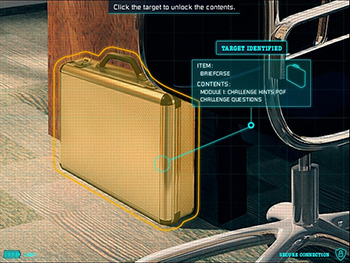
Figure 4: Learners use their“smart glasses” to identify sources of hidden information and solve challenges
Even the dream team hits speed bumps
While designing and developing the eLearning programs, theteam faced challenges that are familiar to many IDs and developers. Among them:
- Contentchanges late in the game—Though Gusmati said that changing content late inthe design is “one of the worst things you can do” to an ID, it happens often.But the team’s design actually lessened the impact of late changes. Themicrolearning game was carefully designed to present challenges that testedessential knowledge, but the course covered a lot of very dense content.Different learners need different pieces of information. Wanting to ensure thatthe eLearning would be engaging and fun, the team distributed the contentbetween online course content and external, downloadable content. Rather thanstuff everything into the game, Gusmati said, “we kept concepts, the mostimportant pieces that we wanted to test the learners on—that got into the course. Butall the information they would need to answer the challenge questions—ifthey didn’t know the answer already—was in these downloadable PDFs.” Duringthe game, learners can unlock the keys to access the content and download it ifthey want. A wonderful benefit of that design is that, when they needed significantchanges well into the development cycle, they could easily update the PDFdocuments; the eLearning module, with its complex design and coding, did notneed to be altered.
- Is thisbelievable?—While learners willingly suspend disbelief anytime they enterinto game-based learning, the missions and challenges have to be believableenough that they will remain engaged. The learners are sent on a multiple-mission“scavenger hunt” where they need to find information that is hidden in thingslike briefcases or furniture in different locations. Gusmati said, “We wanted abig variety of things, but it had to be believable”—learners had to be willing tobelieve that information could be hidden in the objects that they werediscovering and clicking on. “We were able to find the right level ofsuspension of disbelief without going overboard,” Gusmati said, to keeplearners engaged.
- Tightdeadlines—Keckan credits the group’s approach to project management withkeeping them on track despite tight deadlines. “We had very strict deadlines,” hesaid. “How did we meet those deadlines? A lot of communication and flexibility.We worked out a plan to minimize the length of revision cycles by incorporatingan agile project management process.”
A lot of successful design comes down to balance:
- Content—IDs must presenteverything learners need to know without overwhelming them or forcing people tospend time on material they know.
- Creativityand complexity—The design must balance creativity and game elements withcomplexity; if activities or elements are not believable, or the game is socomplex that learners become frustrated before they even encounter theimportant content, the eLearning is ineffective.