“To win in themarketplace you must first win in the workplace.”
—Doug Conant
CEO, Campbell’s Soup
Many of us are looking for a way to get our handsaround the broadening of our field and our evolving responsibilities, from justthe classroom to the workplace, and from just training to a wider array ofsolutions. A learning and performance ecosystem, introduced last month, helpsus get there. Its purpose is to enhance individual and organizational effectiveness by connecting people, andsupporting them with a broad range of content, processes, and technologies todrive performance.
The six components
The ecosystem framework, also introduced last month, showcased sixprimary components that are used to craft an infinite number of dynamic learningand performance solutions (Figure 1).
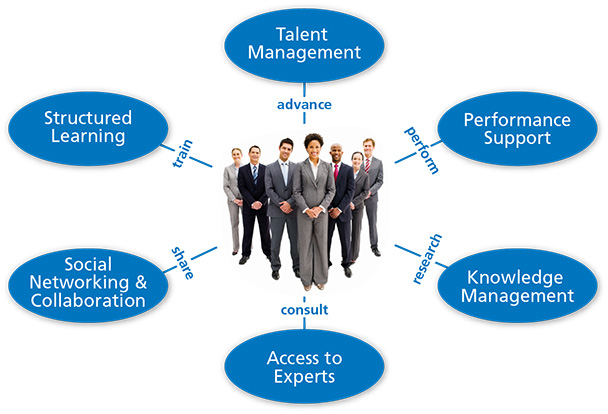
Figure 1: The six primary components of a learningand performance ecosystem
Talentmanagement. Here, people seek to move their careers forward andfind the best place for themselves in the organization. The organization, inturn, seeks to allocate its workforce in the most efficient and productivemanner. From the workers’ perspective, the goal is to advance. From the organization’s perspective, the goal is to manage and develop the workforce.
Performancesupport. Here, people seek assistance at the moment of needby employing performance-support tools in the context of their work tasks. Fromthe workers’ perspective, the goal is to geta job or task done. From the organization’s perspective, the goal is to improve productivity and reduce errors.
Knowledgemanagement. Here, people access content in support of theirwork. From the workers’ perspective, the goal is to successfully research a topic and get answers quickly. From theorganization’s perspective, the goal is to provideeasy and reliable access to information.
Accessto experts. Here, people look for help from more experiencedpeople, sometimes in the form of coaching and mentoring, but also more informally,including getting assistance from a colleague, calling a help center, or evenasking the boss. From the workers’ perspective, the goal is to consult with experts to resolve aproblem or issue, or grow their capabilities over time. From the organization’sperspective, the goal is to most effectively leverage expertise.
Socialnetworking and collaboration. Here, people shareinformation and insights with one another so that the collective knowledge andexperience of a group helps everyone solve a problem, improve performance, etc.From the workers’ perspective, the goal is to share. From the organization’s perspective, the goal is to encourage exchange of knowledge and ideas.
Structuredlearning. Here people avail themselves of precisely designedlearning programs (classroom and online) that help build skills and knowledge.From their perspective, the goal is to learn.From the organization’s perspective, the goal is to train, certify, and meet compliance requirements.
Nine characteristicsof a learning and performance ecosystem
Beyond its definition, thereare nine main characteristics of a learning and performance ecosystem:
Itis performer-, or user-centric.The primary focus is on users and performers, not on content, process, ortechnology. The best measure of the effectiveness of a learning and performanceecosystem is, first and foremost, the value it brings to users. In so doing, italso brings value to the organization as a whole.
Itis part individual and part social.Components can be used by individuals working alone, or by varying sizes of communitiesworking together toward a common goal.
Itinteracts with and is influenced by the culture of the organization. How it works, and howsuccessful it is, depends on the culture of the organization. User acceptance,management sponsorship, openness to experimentation and change, technologicalsavvy, and prevailing attitudes toward learning and performance are keyfactors.
Itis an expanded toolbox of resources for the designer or developer. They can leverage thecomponents in hundreds of combinations to address nearly any learning andperformance problem or opportunity. Relying on a single solution—even a goodone—no longer works. The adage “If all you have is a hammer, everything lookslike a nail” rings true for too many of us, and that attitude must change.
Itis part managed and part self-directed.It may combine purposefully designed content and locked-in programs withuser-generated content and social mechanisms.
Itis adaptable. Each user, or usergroup, can customize it in different ways to meet unique requirements. There isno lockstep or single way to do things. Changes in the environment (e.g., newuse-models, new audiences, time or financial constraints, or advances intechnology) may result in different applications of ecosystem components. Forexample, a sales team facing a customer deadline may use selected ecosystemcomponents differently than an IT organization implementing new software.
Itis organic and evolves over time. Itwill change over time. Elements that were once critical to the ecosystem becomeoutdated and die off, replaced by new elements that did not exist even a fewyears earlier. You must allow a learning and performance ecosystem to evolvewith the changing nature of work.
Itis expansive and holistic.A learning and performance ecosystem takes the most comprehensive view ofpotential approaches and solutions to the need at hand. There is no artificialdeterminant as to what content, processes, and technologies can beincorporated, beyond simply what works.
Itis enabled by technology.The desire to associate a learning and performance ecosystem with softwareapplications is strong, but technology alone, like an LMS for example, is notan ecosystem. You can acquire and assemble technologies into an infrastructurethat helps enable the ecosystem, buttechnology alone is not enough. Theright people, processes, and content, coming together with technology is what’sneeded.
It is all about connections
Theaim of a learning and performance ecosystem is to increase productivity. Theecosystem does this by introducing a lattice of enhanced connectivity to thework environment. Through the ecosystem, workers become better connected withthe people, processes, content, and technology that help them learn, perform,and succeed.
A learningand performance ecosystem is not just technology or merely a set of featuresand functionality. Ultimately, it must be active, alive, and thriving. It livesthrough its use by people. Without people using, interacting, connecting, andderiving value from it, the ecosystem becomes useless and dies.
There will beno learning and performance ecosystem if there is no real change in our views aboutlearning and performance, and about how we practice our craft. The newdirection is clear: from an exclusive focus on instruction, to a much broader,more strategic suite of solutions that go beyond the classroom, and even beyonddelivering training to the workplace, to increasing emphasis on embeddinglearning into the workflow. It’s time to move forward, being mindful of anancient proverb: “If we don’t change our direction, we’ll end up exactly wherewe are headed.”
Learn much more
Wantto learn a lot more about learning and performance ecosystems? Learning and Performance Ecosystems: Strategy, Technology, Impact, and Challenges, thenew eLearning Guild white paper, explores this concept in depth. It’s free toall Guild members.
Note: Steve Foreman contributed significantly to this article.