Museum field trips are about to get a lot more interesting—ina way that has important ramifications for corporate eLearning.
Picture this: As a child or small group approaches a coolexhibit, a nearby iPad tablet comes to life, welcoming the museum-goers andoffering fun, interesting, and grade-appropriate content and activities. The childrenread content, play games, answer questions presented on the tablet, and enterfree-text reactions to the exhibit. At the end of their visit, each child getsa personalized printout that summarizes his or her activities and learning.Best of all, this is all accomplished without sharing a shred of personal infoabout the schoolkids with the app or the museum.
Smoke and mirrors?
Nope. Beacons and badges.
DEEP, an acronym for Digitally Enhanced Exhibit Program, willroll out at the Ann Arbor Hands-on Museum in spring 2017. The solution, created by TorranceLearning, is scalable andversatile with countless potential uses, offering tremendous potential tocorporate eLearning developers and designers.
The secret? DEEP pairs an inexpensive beacon—a small plasticchip with Bluetooth signaling ability—with an ID badge for each learner.
Breaking down barriers
In developing DEEP, TorranceLearning has literally “flippedthe typical use case for beacons,” according to CEO Megan Torrance.
An initial widespread use of beacons was to beam ads orcoupon offers to retail customers. The beacons were located in stores, and theytriggered an app in consumers’ smartphones, pushing a notice with an offer orad to any device within range that had the appropriate app. Not only did thisapproach have the potential to annoy customers if too many ads were pushed totheir devices, it relied on each potential customer to proactively download acompatible app onto a smartphone or tablet and allow push notifications.
DEEP turns that model on its head, securing the technology thatruns the app—iPads—in place near selected exhibits, while the beacons, onlanyards with the badges, travel throughout the museum with the children.
In choosing to distribute beacons to learners, rather than requirethat each learner carry a smartphone or tablet with the appropriate appinstalled and activated, the program overcomes a significant obstacle towidespread beacon use. “In the museum’s situation, it’s completely untenable tohand out smartphones to hundreds of elementary students each day,” Torrancesaid. “By mounting the expensive technology securely to the wall and putting a$5 beacon on the student, the museum overcomes this barrier.”
The innovative app won Best in Show at The eLearning Guild’sDevLearn 2016 DemoFest competition, held in November in Las Vegas.
Groundhog and Brown Bat tour the museum
The museum will use themed sets of badges, such as Michiganmammals or native plants. A set will be used for each visiting class of elementary-schoolpupils; based on reservations made by classroom teachers, the beacons will beprogrammed with content tailored for the appropriate grade level. The content,prepared for each grade level, tracks specific state science curriculumstandards.
Each child in the class will receive a badge with anattached beacon, becoming Groundhog, Brown Bat, or White-Tailed Deer for theday. Only the teacher will know which pupil has, say, the Groundhog badge(Figure 1). The blue chip is the beacon.
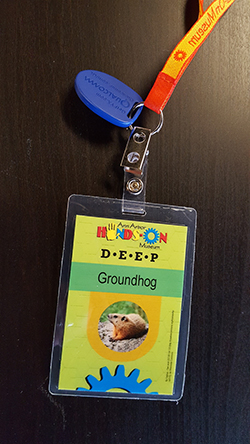
Figure 1: Badge with attached beacon
As the children wander through the museum, alone or in smallclusters, the beacons use Bluetooth to “talk” to an app that is installed oniPads located at select exhibits (Figure 2). As the child approaches an iPad,the beacon causes the tablet to “wake up.” The app greets each child, using thename on the badge, and offers content, activities, and questions. Designed withfast-moving children in mind, the app can recognize multiple beacons at once,address an individual or small group, and be programmed to allow long-termlogins or to log out a beacon once the bearer moves out of range. Up to sixchildren can interact with an exhibit simultaneously. And, if the children arefrom more than one class, the app is programmed with rules that determine whichcurriculum appears on the iPad.
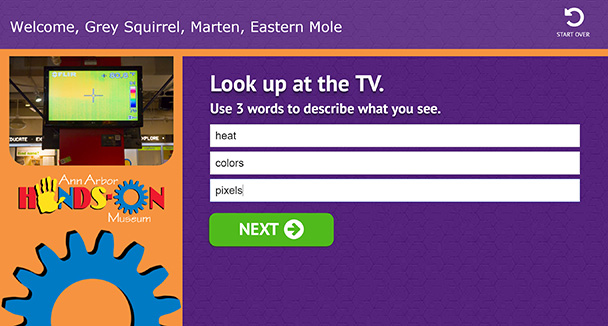
Figure 2: The app
Personalized eLearning that protects learners’ privacy
The beacon-and-badge combination, along with an xAPIinterface in the app, creates a highly personalized experience for the childrenwhile simultaneously alleviating privacy concerns. The app asks questions,offers interactive activities, and records each child’s responses, using the nameson the badges. The app creates xAPI statements describing the children’sactivities; these are used to generate a printed summary of each child’s day. Thechildren get their reports before leaving the museum (Figure 3).
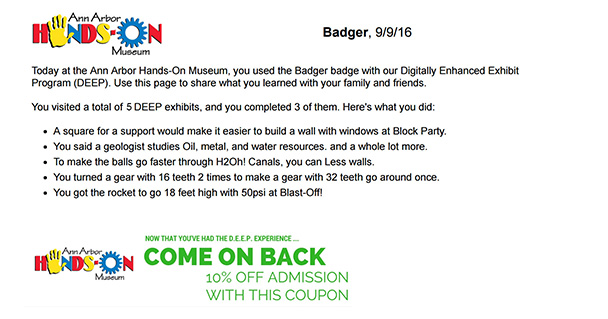
Figure 3: The report
The xAPI data also allows the teacher to generate anaggregate report for the class, as well as more detailed reports for individualpupils. While the teacher can correlate individual responses with the children’snames, no one else—not the app, not the museum—has any personal informationabout the learners. “Absolutely no personal information about the students iscollected,” Torrance said. “We know them as ‘Groundhog.’ The teacher knows whowas Groundhog and who was Brown Bat, but the museum never does.”
DEEP is easily adaptable to a corporate eLearningenvironment, Torrance said. “In the corporate, healthcare, manufacturing,military, or education application, beacons, RFID tags, employee badges, orother technologies can be used to identify employees as they walk into a room,approach a piece of equipment, or move around a location. Beacon proximityreadings can be used to determine how close the person is and who else ispresent. … Learning and performance support content can be displayed on anadjacent tablet, like [in] the museum, or embedded into software and screensalready on a device. This allows for the immersion of content and experienceswithin the work environment and a seamless transition between working andlearning.”
xAPI enhances data collection
Integration with xAPI enables detailed tracking andrecording of learners’ location, activity, time spent per activity, andprogress through an eLearning module. If learners complete a task or anassessment, scores are recorded. If they read an article, visit a location, oranswer a question, xAPI statements record that activity. DEEP can record whichlearners are present, who answers a question, and whether the answer iscorrect.
And xAPI compatibility enables even greater customizationand integration—beyond DEEP. “In the workplace learning environment, xAPI datafrom DEEP can be stored and reported along with data from other learningexperiences, providing a rich picture of an employee’s activity,” Torrance said.“What’s more, xAPI activity recorded by other learning and performanceapplications could be used by DEEP to offer more personalized content andfunctionality.” The detailed data records are stored in a learning record store(LRS), an xAPI-compatible database.
The flexible design also supports a high level of engagement:Text and graphics, multiple-choice and multiple-response, free-text entry,drag-and-drop, and other interactive techniques are used to engage learners,Torrance said. Using xAPI increases that flexibility. “By using xAPI as thecommunication specification, DEEP is interoperable with other learningapplications both now and into the future,” she said. “This means that thesystem can be expanded, or the data gathered from a DEEP experience can betracked and compared with other data sets.”
In addition, it’s easy to add and update content and managelearners’ experience by setting interaction rules and ranges for beaconcommunication. For example, in the museum app, visitors who are not part of agroup can use the iPads to select non-grade-specific content. And if multipleclasses visit the museum on the same day, the app follows rules that governwhich curriculum is displayed when children from more than one group arenearby.
“We identified very early on that this was an idealsituation for using the emerging xAPI specification for a number of reasons,”Torrance said. “While on its face this may look like just another fancy eLearningapplication, the complexity and variety of interactions far exceeds the SCORMstandard’s capabilities. Whereas SCORM tracks a single logged-in LMS user at atime, DEEP needs to handle multiple visitors in and out of the experience on aquestion-by-question level.” For the museum app, it was important to make theinteractions quick, so DEEP does not require that learners log in separately ateach learning station.
The overarching objective is personalization and delivery of contentthat is appropriate for the individual learner, the location, and thecontext—even if that sometimes means denying access. “The goal is forthe environment to seamlessly recognize the learner’s presence and enough ofthe right personal information in order to determine what to do next, whetherit’s to offer up training and reminders, serve targeted goal-oriented messaging,or even to lock an unqualified individual out of the system,” Torrance said.