



Oneof the sure ways to start a long-lasting thread in most discussionforums or LinkedIn groups is to ask whether Twitter (or any othersocial medium) is useful as a channel for learning. Many of thereplies in threads on this topic indicate a profound suspicion of anyapproach to learning that does not involve instruction by an expert,preferably in person, in a classroom.

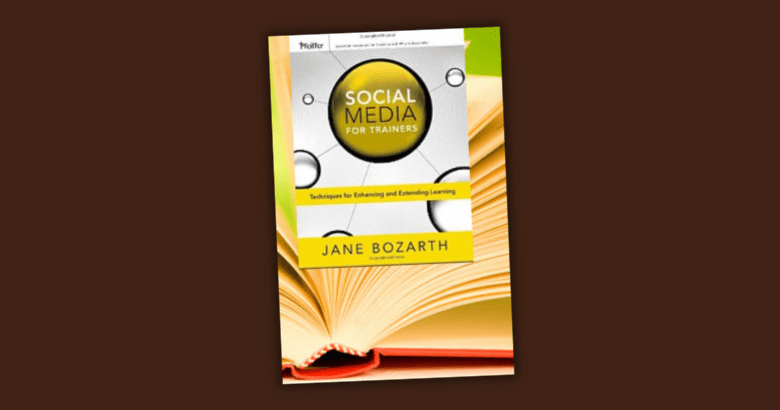
JaneBozarth has provided a valuable resource for social media skepticsand fans alike with her new book, SocialMedia for Trainers: Techniques for Enhancing and Extending Learning.Dr. Bozarth, the Elearning Coordinator for the state of NorthCarolina and the Social Media Strategist of InSync Training, LLC,shows how social media can increase the reach and impact of trainingefforts, without increasing the cost.
What’s in the book?
Inseven chapters, Bozarth covers the basics of social media and themost accessible of the social media: Twitter, Facebook, LinkedIn, blogs, wikis, and a handful of ancillary servicesfrom Google Docs to YouTube to social bookmarking. These are allpublic spaces on the Web, and are generally free to try out and touse.
Eachof the chapters begins with an “In a Nutshell” overview and thenproceeds to expand on that with an explanation of the functionalityof the highlighted service. She includes a short but useful summaryof the advantages and disadvantages, and suggestions as to why one should usethis instead of or in addition to something else. For example, in thechapter on wikis, she points out that wikis are forcollaborative work, so they are ideal Web 2.0 tools for large groupprojects or for knowledge databases, especially if supplemented byother services for discussion, or for photos and other lessstructured interactions.
The chapters continue with an extensive discussion of how to get started using the services, fromsetting up an account to hosting an online course or supporting atraditional course, using the service. These are not abstractdiscussions – each one provides specific examples from realcompanies, complete with screen shots. (There are over 70 figures inthis 175-page book, more than enough to guide the reader) Bozarth’sexamples are extremely complete, including how to use the mediumunder discussion to support pre-work, intersession work, class notes,“lifelines,” reviews and FAQs, post-course interactions, as well as how tobuild a learning community.
Iwould like to particularly recommend Chapter 7, “The BiggerPicture.” This is where Bozarth takes the concept of sociallearning up a notch, to the organizational level. She gives conciseoperational explanations of what “learning” and “sociallearning” are and two of the contexts they exist in online:personal learning networks (PLNs) and communities of practice (COPs), andthe theoretical and research foundations for these (The eLearningGuild is a COP). She also explains how knowledge management is differentfrom information management.
Iespecially liked her great explanation of social learning as “whathappens in the spaces between formal events … not only how to dothings, but how to get things done” in the real world at work. Thebook concludes with an extensive checklist of strategies that willhelp you if you are just starting to implement social learning inyour organization.
Ina world that moves, changes, and shifts as rapidly as social media,keeping the content of a book like this current can be a real issue. GoogleWave, discussed as one of the “other” tools, has already beendown (and is now back up again) since publication of SocialMedia for Trainers.Ning has transitioned from being a free service to one that usersmust pay for. Bozarth is keeping up with the changes on her Weblog:https://bozarthzone.blogspot.com/2010/08/updates-to-social-media-for-trainers.html
Who is this book for?
Onthe flyleaf, the publisher suggests that, “This book is meantprimarily for trainers working in the traditional four-wall classroomenvironment. Those engaged in instructional design as well as thosedelivering instruction via virtual technologies will find informationof use here.” In my opinion, that’s good, but there’s more.
Itseems to me that you will find SocialMedia for Trainersinvaluable if you are an instructional designer and you have toexplain social media to your boss. An instructional designer may alsofind that the examples spark new ideas for ways to support learning,to extend learning, and to open channels for innovation andcollaboration. You can also use the book as the source ofexplanations of social media to share with learners, some of whom maynever have used any social media, or whose use of social media mayhave been, shall we say, superficial.
Recommendation
I’ma fan of this book, and I recommend adding it to your how-toresources. Keep it on your desk, not on a shelf. More importantly, Irecommend that you try out one or more of the social media foryourself, and then incorporate the use of that service in the nextcourse or event that you design or lead.
Bibliographic information
Bozarth, Jane. (2010) SocialMedia for Trainers: Techniques for Enhancing and Extending Learning.San Francisco: Pfeiffer. 175 pages.
The author speaks! Listen to Jane’s Thought Leader Webinar on “New Skills for New Media”: https://www.elearningguild.net/tlws/tlws13.wmv


