As a woman, I think eLearningis a great field to work in. I’ve never encountered the kinds of dramatic andpersistent sexism that occurs in other technology-related fields like computerprogramming and video game development. Many of our best companies are managedor owned by women, and we are closer to a balanced gender ratio than manyfields.
That said, we aren’tperfect, and many of the persistent gender issues that occur in the modernworkforce (e.g., gender pay inequity) are just as present in eLearning as inany other field.
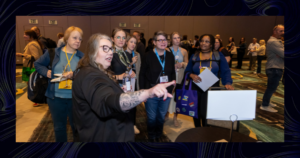
At DevLearn 2014, Ihelped organize a panel called Bridging the Gender Gap to look at some of these issues. Bill Brandonattended and suggested we collaborate to run a series on this topic in Learning Solutions Magazine.
The articles and links
I wrote the firstarticle myself—Women in the eLearning Field: Beginning a Conversation (January 22, 2015). I was curious why the gender diversity that I knew existed inthe field wasn’t being represented at some of our events. To investigate that,I looked at what was happening at the system level to influence outcomes.
Next, Koreen Pagano tooka deeper look at what some of the issues are, and how they affect women inmanagement and leadership roles in The Gender Riddle in Learning and Development(February 19, 2015).
Mark Lassoff, who hasworked on helping get women and girls involved in computer programming, wrote Women in the eLearning Field: Was Your Father a Programmer? (March19, 2015), inwhich he talked about the disparities in the tech fields, and his ownexperience witnessing gender bias.
In Women in eLearning: We’re Bringing Women into Tech the Wrong Way (April 16,2015),Aisha Taylor talked about some of the limitations of the current dialogue aboutwomen in tech. She exposed some of the limitations of how we are defining“working in technology,” and reminded us (as would other contributors) thatthis isn’t about women learning to be more like men, but rather about bringingour authentic selves to work.
One of the persistent issueswhen dealing with any group inequities is the fact that often people from thatgroup are unfairly dubbed the representative of their whole group. For exampleif a woman gives a bad keynote at a conference, it gets pointed to as proofthat trying to find women keynotes is a bad idea (I’ve witnessed thispersonally) while a man who gives a bad keynote only represents himself. In Women in eLearning: Language, Gender Equality, and Leadership (May 21, 2015), David Kelly talksabout the importance of being careful with language, and how to labelbehaviors, not people.
In Taking Responsibility for the Gender Gap (June 18, 2015), Sam Savela cuts throughthe doubletalk that can occur, and challenges the oft-expressed notion thatwomen are primarily the ones who need to change their behavior in order toredress some of the imbalances. She cites several case studies of organizationswho are addressing inequities head on.
In Navigating Differences(July 21, 2015), Ellen Wagner wrote a lovely piece on recognizingthe issues in the system while also being honest with yourself, and how to makesure you are owning your seat at the table.
In her article Women in eLearning: A Brave New Digital World (August 20,2015),Lauralee Sheehan takes on the idea that “women in tech” has to be definednarrowly, and that the blend of creative and technical is part of the diversityof the field.
In one of my favoritepieces of the series, Trina Rimmer takes on the issue of diversity in ourvisuals in The Lack of Diversity in Stock Images Hurts Your eLearning—and What to Do About It(September 17, 2015).Trina writes a detailed, practical, and applicable piece on how to ensure youaren’t unconsciously reinforcing stereotypes in your eLearning, and how to showwhat real diversity looks like.
In Gender Representation in eLearning (October 22,2015),Judy Katz expands on the question of gender representation. I was reallypleased that she also addresses the inclusion of transgender people in theconversation, in what I suspect is the first discussion of that topic in Learning Solutions Magazine.
In Women in eLearning: Micro-inequities Add Up to Macro-inequities (November 19,2015),Karl Kapp wrote a really nice and nuanced piece about how to mentor and supportfemale students.
Summing up
I’m also particularlypleased that the last piece in the series focused not on the challenges in the eLearningfield, but rather on how eLearning can be part of the solution. SahanaChattopadhyay wrote a great piece on how eLearning can help address educationgaps in India in her article Re-skilling Women: Could eLearning Be the Answer? (December 17, 2015).
In retrospect, I’m reallyglad we had the opportunity to dig deeply into a complex issue and involve somany voices in the discussion. I learned a lot from my fellow contributors. Oneof my favorite lessons was on the importance of inviting men into the conversation.I knew from the outset that I wanted to avoid the implication that this is onlya topic for women to discuss amongst themselves (it’s not), but I wasinterested in how surprised (though not unwilling) some of the men were to beasked to contribute. But complex system-level challenges require system-levelsolutions, and that means we need to have everyone at the table for theconversation. My thanks to all the contributors, and Bill Brandon and The eLearningGuild for making this particular conversation possible.