We had discussedtheir training needs together, agreed to a general approach, and evendiscussed ADDIE at the kick-off meeting. Everyone was aware that theschedule was aggressive. Somewhere in the middle of the project,though, it became clear my team wasn’t matching the expectations ofour customer.
When it hit, therealization that our two teams had walked away from our friendly andagreeable meetings with different ideas about the project and theprocess was more than just personally frustrating; it was also acostly mistake for the team. We had estimated our costs based on aprocess our customer wasn’t willing to accept, and it would takemany more hours to conform to their process than we had available ina work week. In retrospect, my team’s failure to make our projectmanagement strategy clear and explicit was a key learning moment,well worth the personal cost of a month of 80-hour weeks.
Find out what’s important
Time probably wasthe most important factor to this particular customer, but the factis, we never knew for certain. We never checked our assumptions, orasked them to recognize the other constraints around the project. Allprojects have constraints: the time available, the amount of moneythe customer can spend on the project, and the quality required tomake the project effective.
The easiest way tolearn what’s most important is to draw a triangle listing one ofthese constraints on each angle, and then ask the customer to pointto the one they care about most. (See Figure 1.) If quality is mostimportant, the customer may have to give up some money or makeconcessions about the time to complete the project. If time is mostimportant, the customer may need to be more flexible about moneyand/or quality.
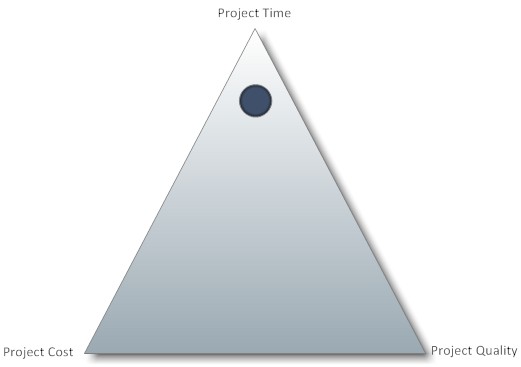
Figure 1. The constraints triangle
Get agreement early
Armed withinformation about what’s most important to the customer, the nextstep is to document your project plan explicitly, with special focuson exactly what work product the customer should expect at each stageof the project. Take special care to define your terminology.
For instance, ifthe plan includes a storyboard in PowerPoint, the customer may needclarification on what the storyboard is (and isn’t) meant to do. Some customers get the impression that the PowerPoint should containall the same functionality as the finished eLearning project; otherscan’t visualize how the animation might work without a workingexample. Writing down what you plan to do and why makes the processtransparent, and gives the customer the opportunity to weigh in onany steps you may have omitted.
Hold a projectkickoff meeting, and read through the written project plan with thecustomer. Answer any questions they may have about the process, butoffer them a set amount of time after the meeting to review andrevise the plan. Encourage them to read the document carefully,revise any parts they want to handle differently, get clarificationon any parts they don’t understand. When they agree with whatyou’ve written, get a signature or other written approval to showthat everyone is on the same page.
Get agreement often
The issues that candrag an eLearning project out of scope are often modifications madeat the wrong time, such as changes to the script after the media isrecorded or the addition of a logo after the layout has beendeveloped without one. As a project moves forward, customers oftenforget the process outlined at the beginning of the project, despitehaving approved, or even modified the process.
To help keep theproject and all of the players on track, the written plan shouldinclude checkpoints calling for additional approvals throughout thelife of the project. As you present work products for approval,remind the customer of your current stage in the project, what thecurrent work product is (and isn’t), and ask for a signature orother written approval of the work product. Some good checkpoints toinclude in the process are developing layouts and color schemes,finalizing the script, and completing storyboards.
If, for somereason, the work product doesn’t match the customer’sexpectations, the frequent checkpoints will help ensure that theproject doesn’t get too far off track before the customer has theopportunity to request corrections.
Don’t skip any planning steps
It can be temptingto skip some project planning steps when faced with a tight deadline,or when project planning meetings seem to reveal that everyone has acommon understanding of the requirements. Writing out each of thesteps in a project plan can be time-consuming, but clear expectationsand boundaries around your process make the project go more smoothly,and keep the business relationship worthwhile for everyone.