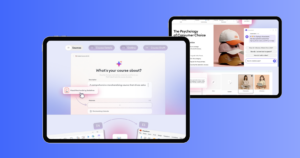
The eLearning Guild’s latest case study describes how a cross-functional team at PwC, a globalprofessional services network, used interactive video to support a learning andmarketing program for digital transformation. PwC is driving digitaltransformation through a combination of business, experience, and technology(also known as the BXT method). This program, EnhancingDigital Capability, forms anoverarching framework that encourages learners to move from digital“awareness” to “fluency” and, ultimately, to “expertise.”
PwC is one of the largestprofessional services networks in the world, with over 223,000employees in 743 locations within 157 countries. The network offers a widerange of industry-focused services for publicand private clients that include audit and assurance, consulting, cybersecurityand privacy, people and organization, and tax services.
In the United States, PwC isheadquartered in New York and operates as a subsidiary of PwC InternationalLimited. This case study describes an interactive video solution created by acollaboration of various groups (hereafter the “digital learning team”) aroundthe world, including US Learning & Development, Global Consulting Learning& Development, Global Digital Learning and Human Capital, and PwC DigitalServices.
What does “digital” reallymean?
Karel Dörner andDavid Edelman, writing for McKinsey Quarterly in 2015, asked: “What does ‘digital’really mean?” They answer by asserting, “We believe digital should be seen lessas a thing and more [as] a way of doingthings.” According to these authors, thisconcept of “digital” encompasses three processes: “Creating value at the newfrontiers of the business world, creating value in the processes that execute avision of customer experiences, and building foundational capabilities thatsupport the entire structure.”
The interactive video initiativedescribed in this case study is called DigitalAwareness, and it exemplifies the “vision of customer experiences” and the “foundationalcapabilities” that Dörner and Edelmansee as essential for today’s digital world.
People challenges in a digital world
In response to today’s business challenges, professionalservices firms are evolving to meet the changing needs of their clients and thejob requirements of the emerging global workforce. These firms must not onlycompete for the best and brightest talent, but also confront the fact thatcommunication channels and development approaches for attracting and retaininghigh-quality talent are also transforming. The world is now digital, and employersare facing the reality of recruiting a workforce that has deep familiarity withtechnology and responds best to employers that demonstrate digital relevance, or the increasing need to create digital content that has genuine meaning andrelevance for the intended audience.
Matthew Murray, digital learning leader forPwC’s US Learning and Development Group, says one of his most critical peoplechallenges focuses on the needs of the modern worker:
With a large, tech-savvy, and client-focused population,we must provide learning that is engaging and modular. Our staff expectlearning to be high-quality, easily accessible, and comparable to what they experiencein their daily life. We need to provide greater awareness of PwC’s breadth ofservices and digital capabilities so that our staff can have strongerconversations with clients. As part of our commitment to attract and retain toptalent, we have to demonstrate that PwC is digitally advanced and is providinglearning in a forward-thinking way.
Let’slook at several key reasons why the ability to demonstrate digital presence is essential for successfully attracting,training, and retaining today’s high performance talent.
Note:Many industry analysts use digital relevanceand digital presence as essentiallyinterchangeable terms. In this case study, we use digital presence, while acknowledging that other analysts—such asArdith Albee—prefer the term relevance.See the case study for more details and resources on this topic.
Millennialsas digital consumers
Thereis an increasingly large body of research and opinion on the characteristics ofMillennials as digital consumers and digital learners. Rather than review thatbody of literature, let’s summarize what we know about Millennials as digitalconsumers.
Settingthe stage: According to a Pew Research Center analysis of 2015 US Census Bureau data, Millennials (estimatedat 75.4 million individuals in 2015) have surpassed Baby Boomers (74.9 million)as the nation’s largest living generation (Figure 1).

Source: Pew Research Center, 2016
Figure 1: Projected population by generation
Ina blog post, the digital marketing group FlashStock identifies six characteristics of digital marketing content that have proved effective in marketingideas and products to Millennial consumers. In this same post, FlashStock CEOGrant Munro writes that digital materials should be relevant, educational,entertaining, authentic, cutting-edge, and socially responsible.
Infact, interactive learning video is particularly relevant to the “cutting-edge”characteristic, appealing to early adopters of new technologies and thus,uniquely suited to employers who present a positive and effective digitalpresence.
Theimportance of digital presence
Creating cutting-edge interactive videothat appealed to internal staff was a key requirement for PwC’s EnhancingDigital Capability project team. Fortunately, the team was able to leverage analready strong digital presence and use this to their advantage.
How important is having adigital presence? According to Tom Cochran, writing in Entrepreneur magazine, “If you don’thave a digital presence today, you don’t exist.” Furthermore, asSarah K. White observes in CIO, “If your business is lacking in digital presence, Millennialsmight be wary about applying. It could imply that the business is behind thetimes or unwilling to evolve.”
The digital marketing group webSURGEdefines digital presence as “simply how yourbusiness appears online” and notes, “Your digital presence is your onlinereputation.” The group goes on to say that a positive digital presence isessential to business success: “In today’s era of technology and digitaladvancement, a strong digital presence is vital if you want to see success onthe Internet. A lot is happening online. Traditional marketing is stillimportant, but you don’t want to miss out on potential customers who are mostly—maybesolely—online.”
Insummary, digital presence is essential for recruiting and marketing. Accordingto webSURGE, an effective digital presence allows employers and marketers ofall types to:
- Create visibility.Information seekers should be able to learn everything there is to know aboutyour company from your digital presence.
- Establishyour authority. Demonstrate industry knowledge and expertise, build trust,and explain why your company is the best in the industry.
- Build rapportand relationships. The Internet audience is composed of people, and people arerelational. Digital presence should enable your company to show a human sideand to offer something that can help your consumers or potential recruits.
Beforewe look at PwC’s video initiative, let’s examine the partnerships that PwC undertookto create the end result, as well as the organizational learning context inwhich the interactive video project took place.
Partnerships
PwCpartnered with two production and technology firms to design, create, anddeploy Digital Awareness. Thesepartners were The Electric Factory and Rapt Media.
The Electric Factory helped produce the interactive experience. The company wasinvolved from brainstorming and scripting to shooting, editing, andpost-production through its in-house company NIKO Post & Films. Also, TheElectric Factory designed, developed, and tested the interactive experience. Withproduction offices in Argentina, Paraguay, and Uruguay, andcommercial offices in the US, Chile, China, Spain, Panama, and Puerto Rico, TheElectric Factory is a creative innovation group responsible for co-creating,developing, and implementing strategies, products, and solutions that haveredefined the value of interactive experiences in advertising.
The second partner was Boulder,Colorado-based Rapt Media. Rapt Media provides a compellingalternative to engage employees and consumers, inspiring them to act. Its cloud-basedinteractive video platform drives deeper engagement, resulting in enhancedlearning and rapid behavior change.
PwCand The Electric Factory worked with Rapt Media to enable the Digital Awareness videos to optimize thecapabilities of the Rapt Media interactive platform. The team did this by usingAPIs (application programming interfaces) to extend the native capabilities ofthe hosting platform, so that different videos are displayed based on deviceused, and video users are presented with a “conclusion” screen. The additionalAPI functionality enabled the viewer to “unlock” this screen after clicking ona required number of hotspots.
The organizational learning context
Murray, the digital learning leaderfor PwC’s US Learning and Development Group, described the broaderorganizational learning context in which the interactive video efforts werepositioned:
Our aim is to provideimpactful learning that is easily available close to the point of performance. Ourlearning must be scalable and also personalized, accessible across devices. Wehave a broad portfolio of systems and platforms that enable us to delivertraining in many different ways. We work closely with third-party providers tomake sure that our platforms meet our security, production, and learner needs.
A story-driven learner journey
The goal of the PwCteam was to create a series of story-driven, interactive videos that could beaccessed by staff and partners globally, and also by the firm’s clients andmembers of the public. As such, DigitalAwareness served as one component of a larger “Learner Journey” framework (Figure2) that encourages learners to progress from awareness to fluency and,ultimately, to expertise.

Source: PwC, 2016
Figure 2: Enhancing DigitalCapability learning framework
The goalof Digital Awareness is to generateexcitement for, and awareness of, the ways in which PwC’s digital capabilitiespositively impact the world. In accomplishing this goal, the team facedtwo major design challenges:
- Sustaining a focus on the story while, at thesame time, also permitting the learner to take deeper dives into more detailedtopics
- Creating an experience that feels exciting andspurs interest but does not feel like a sales pitch
In an effort to resolve thesechallenges, the team and their partners designed the video to equally balance twoideas:
- How digital technologies and capabilities impact everyone’s life
- How PwC, as a network of global professionalservices firms, is adding value for clients and consumers in a world that isbeing disrupted and transformed by digital challenges and opportunities
As a way to achieve this balance, theteam decided to limit branching and avoid multiple storylines within the samevideo experience. In this way, they focused on having learners move quicklythrough the same learning points and view the entire body of content.
Usinginteractive video enabled PwC’s team to create character-driven stories thatinvite people to connect and relate to the videos, and then use theirinteractivity features to dive deeper into PwC’s digital services andcapabilities through use of these interactive visual hotspots. Interactivehotspots enable video designers to direct viewers to other sections of a video,give them the option to replay parts of the video, or even launch an externalwebsite or secondary video overlay.
Undertaking the journey
From the digitallearning “hub” (Figure 3), learners can choose which of the three charactersthey wish to follow on the story-driven journey. Each character has a storythat explains how emerging technologies and digital platforms are impactingtheir world and creating opportunities that did not previously exist. Voice-overnarration provides additional insights into the on-screen action as well as amore comprehensive view of the transforming digital landscape. As Murray said, “Eachof our stories has a twist that we think will surprise and delight learners.” However,as he also noted, the team “deliberately avoided too much humor because this was a global initiative”—and humorsometimes does not translate well across cultures.

Source: PwC, 2016
Figure 3: The digitallearning “hub”
From a practical design standpoint,the voice-over narration provides the PwC team with a flexible approach for updatingthe message content in the future withoutneeding to reshoot the video. Another advantage of the voice-over narrationwas that it enabled the team to avoid having the characters speak. Thisaccelerated the video production process, and it increased global relevance by improvingcharacter identification and simplifying the process of translating andsubtitling the narration.
Measuring interactive video success
Feedbackboth from learners and from company stakeholders has been uniformly positive. Withthe launch of Digital Awareness, thePwC team activated its measurement plan and began tracking the followingmetrics:
- Number of hits on the Learner Journey microsite inorder to access the video
- Number of clicks on the video link itself
- Number of internal and external viewers whocomplete all three stories
- Number of internal and external viewers who,after completing all three stories, actually go on to “unlock” the final videosegment
- Number of times internal and invited externalviewers download the Digital Fitness Assessment from the microsite (see Figure2)
- Additional business and goodwill generated byexternal clients who participate in the awarenessand assessment phases of the LearnerJourney
Lessons learned
Murray summarized the following key lessons that he and the PwC team learnedfrom their interactive video experience:
- Deal withinternal security. Deal quickly and effectively with any technical ornetwork-related issues surrounding streaming video and enterprise securityprocesses.
- Create separateversions of the interactive video, one for PCs/tablets and one for smartphones.The use of hotspots and other interactivity elements meant that PwC had tocreate two version of the video, one for use on personal computers (i.e.,desktops, laptops, and tablets) and another version for use on smartphones.
- Test early and test often. Getearly versions of videos out to stakeholders sooner, and do not worry that theylook unfinished. Prototype through early versions, and follow the oldcommunication adage of “show, don’t tell.”
- Keep the coreteam small. With a projectthis size, it is easy for a large group of individuals to lose sight of theoriginal vision. The PwC team was able to hold on to their original vision forthe video by keeping their core team small (three people), although the totalnumber involved in designing, producing, testing, and launching the videoexceeded 80 people.
- Keep the userexperience front of mind. Murray and the PwCteam applied a design thinking approach and user experience (UX) frame of reference.Murray explained, “This meant that we resisted trying to cram too much into thevideo and focused, instead, on what the viewer could reasonably comprehend andabsorb.”
- Take plenty oftime for the video design phase. Allocate a sufficient amount of time to the brainstorming andideation phase, and make sure that the high-level concept of the video isclearly in place. Avoid the pitfall of moving forward too quickly and prematurelywriting the script before all design details are complete.
- Make the storiesand interactivity fun and creative. As discussed earlier in this case study, professional services employeesrespond best to what Murray calls “a clever hook that engages people and keepsthem exploring and learning. We wanted fun and engagement, [with] memorablecharacters that were unique and defied archetypes.”
Looking ahead to hybrid digital learning
Looking to the future of Digital Awareness, and the broaderdigital learning framework to which it belongs, Murray summarizes PwC’s firstsignificant foray into interactive video:
[We meant this video tobe a] high-touch, lean-in, immersive experience causing a high level ofengagement. We tried to balance the ability to watch video uninterrupted versusinteracting with the video. In our design, we made a conscious decision to letpeople just watch and not need to interact with the video if they chose not to.But we also enticed people to interact and delve into the secondary content toenhance their awareness of the digital landscape. [So we] create both paths: passiveversus interactive. [The] hidden final video required learners to interact ifthey wanted to view each story’s conclusion.
I was struck by one other comment fromMurray. He said that what he and the PwC team had created was part of a hybrid digital learning solution (i.e.,the journey framework) that succeeded in “combining learning, communications,and marketing goals.”
This is interesting because asubstantial amount of industry research now talks less about “training” and moreabout “digital learning.” Digital learning has been defined as “learning facilitated by technology that givesstudents some element of control over time, place, path, and/or pace.” Compare this with the following definition from DigitalLearningDay.org,by the Alliance for Excellent Education:
Digital learning is anyinstructional practice that effectively uses technology to strengthena student’s learning experience. It emphasizes high-quality instructionand provides access to challenging content, feedback through formativeassessment, opportunities for learning anytime and anywhere, andindividualized instruction to ensure all students reach their full potential tosucceed in college and a career.
As we saw in this case study,high-quality, interactive video is being combined with other forms of digital contentto achieve goals beyond “just” training. Similar to PwC’s goals, these mayinclude marketing, organizational communication, change management, collaboration,assessment, and beyond. The point is that interactive video is a hybridlearning resource that can enhance the design creativity, learner engagement,and effectiveness of future digital learning solutions.
Take a moment to download this case study and also explore for yourself the PwC Digital Awareness interactivevideo.
References
Alliance for Excellent Education. “About DLDay.” DigitalLearning Day.
Cochran, Tom. “The 4 Building Blocks of a Strong Digital Presence.” Entrepreneur.9 January 2014.
Dörner, Karel, and David Edelman. “What ‘digital’ really means.” McKinseyQuarterly. July 2015.
Fry, Richard. “Millennials overtake Baby Boomers as America’s largest generation.” Pew ResearchCenter. 25 April 2016.
Munro, Grant. “6 Types of Content to Win Over Millennials.” FlashStock Blog. 29 July 2016.
PwC. Digital Awareness. Video.
webSURGE. “What Is Digital Presence for Business?” 15 July 2016.
White,Sarah K. “6 ways to attract and retain millennial workers.” CIO. 21 May 2015.