
Today’s academic learning managementsystems (LMSs) are integral to student learning experiences, faculty teachingexperiences, and the academic institution’s communication and management plans.LMSs are now considered ubiquitous in higher education. In this article, Isummarize the results of our recent academic LMS research study, as reported inAcademic Learning Management Systems 2016 – 2018.
Some observersof the corporate LMS marketplace signala dire future for corporate LMSs. Others are even going so far as to announcethat the corporate LMS, as we know it,will be “dead” in five years. However, observers of the academicLMS marketplace paint a quite different, more positive picture of thefuture. Many in academia and the wider marketplace are increasingly discussingan “evolution” of the academic LMS. Others are looking forward to thetransformation of the LMS into what many now call the “next-generation digital learningenvironment” (NGDLE). NGDLEs are considered “successors” to today’s academicLMSs, and are envisioned as learning environments, or “learning ecosystems,”rather than single, enterprise-level applications.
In our report, we presentedresults from our recent academic LMS research study, cosponsored by AdobeSystems. Invitations to participatein the study were sent to corporate andacademic members of both TheeLearning Guild and Adobe Systems global usercommunities. We received a total of 1,299 responses from more than 35 countriesworldwide. The largest number of responses came from the United States (888responses), Canada (89 responses), Australia (40 responses), and the UnitedKingdom (26 responses). From this combined pool of academic and corporaterespondents, we selected only those who identified themselves as representing academic institutions—either as anacademic professional or an eLearning practitioner. This smaller sample of 312academic respondents was the focus of this research report.
The goal of this research study was to focus on academicLMS usage and characteristics; LMS satisfaction and customer loyalty; andperhaps most importantly, the LMS features and functionality that our academicsurvey respondents said were most important to their organizations. Here is asummary of several key insights from this report.
Cloud-based LMSs continue todominate on-premises LMSs
As shown in Figure 1, more than one-half (64%) of institutionsuse a SaaS-based LMS, while less than one-third (27%) still deploy their LMS onpremises, maintained by their own IT staff. This confirms the continueddominance of cloud-based LMSs over on-premises LMSs—in both academic andcorporate deployments—for the last three to five years.(Editor’s note: Percentagesshown in the figures in this article do not total to 100% in every case, sincenot all survey participants responded to every question.)

Source: The eLearning Guild Research, 2016.
The overall level of academic LMSsatisfaction remains poor to mediocre
Nearly one-half (47%) of survey respondents were only“somewhat satisfied” with their LMS. (Figure 2) This mediocre satisfactionlevel is similar to what has been noted across other LMS industry studies. Sixteen percent ofinstitutions surveyed were “very satisfied,” and 25% were “dissatisfied” or“very dissatisfied.”
We found nearly the same number of 2015 corporate and academicLMS respondents (46%) and 2013 LMS respondents (46%) were equally “satisfied”with their LMS. LMS implementation experiences substantially affect overalllevels of satisfaction, in particular, the elapsed time between the LMSsoftware installation and setup and the critical point at which institutions canbegin actually enrolling students. More than one-third (37%) of institutions saidit took more than three months after initial installation to begin enrolling theirstudents.
Source: The eLearning Guild Research, 2016.
Academic users have slightlystronger requirements for mobile LMS functionality
More than three-fourths (85%) of academic LMS respondents saidtablet support was “extremely important” or “very important.” (Figure 3) Thiscompares with nearly the same number (82%) of 2015 corporate and academic LMSrespondents.
Slightly more than three-fourths (77%) of academic LMSrespondents said smartphone support was “extremely important” or “veryimportant.” This similarly compares with 71% of 2015corporate and academic LMS respondents who said the same.

Source: The eLearning Guild Research, 2016.
Academic LMS users are moreconvinced about the learning impact of gamification
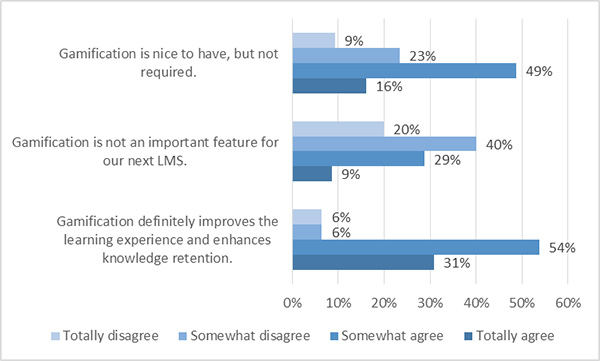
Fully60% of academic respondents said they either “totally disagree” or “somewhatdisagree” with the following statement: “Gamification is not an importantfeature for our next LMS.” (Figure 4) This was consistent with almost exactlythe same number (59%) of 2015 corporate LMS respondents who disagreed.
When asked if gamification definitelyimproved the learning experience and enhanced knowledge retention, slightlymore than one-half (54%) of institutions said they “somewhat agree,” while only31% “totally agree.”
CorporateLMS respondents in 2015 did not seem as convinced about the value ofgamification, and almost three-fourths (69%) said they “totally agree” or“somewhat agree” that gamification is “nice to have, but not required” in afuture LMS.
Source: The eLearning Guild Research, 2016.
Study resultsconfirmed the importance of designing all types of learning experiences(including the LMS user interface) from a learner’s point of view, as opposedto that of a learning and development manager or an LMS administrator.
Academic users identified themost important academic LMS features
Responding to the obvious importance of “learner-centered”designs for academic LMS users, our respondents identified what they believedto be the most important academic LMS features—from the learner’s point ofview. Learner-centered designs have the following attributes. [See the researchreport for all source citations}:
- Context. The scenario in which learners can carry out learning tasks asclose to the real world as possible.
- Construction. Learners better acquire knowledge when they can link their own experiencewith the learning materials and make sense of them.
- Collaboration. The opportunity for learners to develop, test, and evaluate theirideas with peers, which in turn exposes them to multiple perspectives in aproblem-solving case. Jonassen viewed this element as an important part of thelearning process.
- Conversation. Talking with peers strengthens the learning and helps withplanning, collaboration, and meaning making.
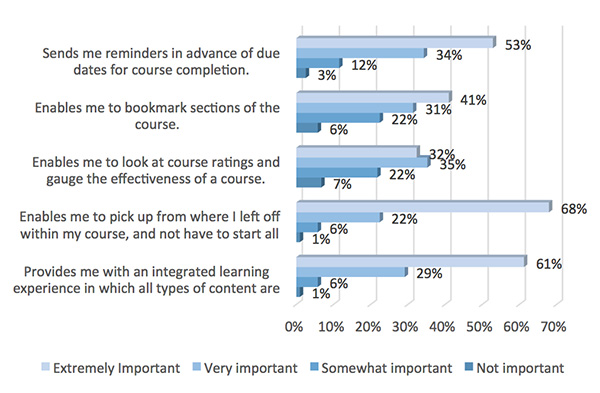
By substantial margins, Figure 5 identifies the threehighest-rated (“extremely important”) academic LMS features from the learner’spoint of view.
Source: The eLearning Guild Research, 2016.
Learner-centered environments, andstudent-centered learning communities, have long been recognized as criticalrequirements for academic LMSs. Interestingly, as one academic blogger noted:
Ina student-centric LMS, the core abstraction of the LMS is the student[learning] resources could be local and within the LMS, or they could beexternal to the LMS or to the student’s current institution … building theLMS from this perspective [enables students to] connect to students and toresources. Instructors would just be another kind of student, ones with perhapssome special abilities (like assigning grades).
These issues are important because they focus on the need foracademic students and workplace learners to have easy access to information“whenever, wherever, and however.” As an industry analyst notes, “Making itpainful for the end user to access the system and to get the relevantinformation when they need it defeats the basic purpose of the LMS and directlyimpacts ROI.”
We believe that today’s academicLMSs will sustain themselves in the near future and continue to evolve intonext-generation digital learning environments.
We concludedour report by stating our belief that academic LMSs will continue their “evolution”and will sustain a more positive view of the future than that currently paintedby corporate LMS market analysts. As such, academic LMSs will be transformedinto the “next-generation digital learning environment” (NGDLE) mentioned atthe beginning of this article.
Aswe saw from these study results, users of academic LMSs should reevaluate theiraging learning platforms and carefully investigate other leading-edge platformsand technologies. All LMS users—whether corporate or academic—need to clearlyidentify their learning management needs and proceed in a direction that enablesthem to deliver the best-possible digital learning experience. The need forclarity of purpose and preparation is more relevant now than ever before,particularly in an LMS marketplace that changes somewhat every day and moresignificantly every year.