
Formore than a decade, the Guild’s salary and compensation reports have beenrecognized as the industry’s most trusted source of data on eLearningprofessionals’ salary and compensation. In our just-published 2017 eLearning Salary & Compensation Report,we introduced new tools and resources for getting started on your own salaryresearch and implementing a salary strategy that works for you.
Inthis article, we take a deeper look at an important topic included in thisyear’s report: the relationship between salary, academic degrees, andprofessional certifications. In addition to a discussion of this key issue, wealso present a simple tool to evaluate where you stand in terms of the costsand benefits associated with obtaining a degree or professional certification.
Salary benefits of an advanced degree
Aswe have seen from our year-over-year compensation data, the level of educationone attains has a substantial impact on average base salary.
Inour 2015 annual salary report, we saw that those holding a doctorate were paidan annual salary that averaged 23.7% higher than the (then) US national averageof $81,079, regardless of industry or public/private sector. Compare this to2016, when those holding doctorates were again paid the highest average salary:$90,847, or 13.05% higher than the 2016 US national average of $80,359. Thosewith master’s degrees averaged an annual salary of $81,041, which was only0.85% more than the national average for that year.
In our 2017 report, education and salarycomparison data (Figure 1) show an understandable progression in average salaryfrom those in the aggregate education category (i.e., high school, somecollege, associate degree, trade school, and technical college) to those withdoctorates.

Figure 1: Average US salary by educationlevel
However, some questions still remain about these data. Forexample, it is not clear why those who fell into the 2017 aggregate category(i.e., high school, some college, associate degree, trade school, and technicalcollege) earned an average salary that was only 4.01% lower than the averagefor those with bachelor’s degrees: $77,583 as compared to $80,827.
Equally interesting, we saw a similar anomaly in 2016, withthose holding bachelor’s or associate degrees actually receiving lower averagesalaries ($78,655 and $73,089, respectively) than those with less than twoyears of higher education ($80,969). One positive note about the 2017 data:Holders of baccalaureate degrees have begun to catch up, with a 2017 averagesalary ($80,827) that is 2.76% higher than 2016.
This year,however, we looked deeper into the compensation benefits of educationalcredentials and widened our focus to include the salary impact of academic degreesplus professional certifications.
Salary benefits of a professional certification
Research indicatesthat professional certifications can have a positive impact on overall wages,even if you already have an academic degree. Regina Robo, writingfor Salary.com, notes, “Certifications and memberships in professional organizationsor trade associations can have a positive effect on pay. However, if a jobcalls for a certification you don’t have, you might not get the job or your paymight be set at the lower end of the range. Some employers require employeeswithout certifications to work toward them.” She goes on to advise that if youhave a professional certification that is considered optional for your job, itcan still serve to help you negotiate for a higher wage (see References).
In more specificterms, both the Professional in Human Resources (PHR) and Senior Professionalin Human Resources (SPHR) certifications have proven their wage-earning valuein recent research studies. According to a 2013 research report from PayScale (seeReferences), “The data shows human resources professionals with the PHR andSPHR designations [move] through the career labyrinth faster and make moremoney than those who lack the certification. This pattern holds across allindustries as well as the largest metropolitan areas.”
There seems to beless agreement about the market value of the Certified Professional in Learningand Performance (CPLP) credential, offered by the Associationfor Talent Development, and the Certified Performance Technologist (CPT) credential,offered by the International Society for PerformanceImprovement. One can find positive reviews of these two certifications, aswell as other, less positive opinions. (See the entire 2017 eLearning Salary and Compensation Reportfor these sources, as well as citations for all references.)
Figure 2 shows that the certification held by the mostsurvey respondents is the Project Management Professional (PMP) credential,offered through the Project Management Institute (PMI). According to 2015 survey results published by PMI, the PMP certification provides a significantadvantage when it comes to salary and earning potential (see References). AmongPMI survey respondents, those with a PMP certification reported a higher salary(20% higher on average) than those without.
Types of professional certifications held by 2017 surveyrespondents
This year, in addition to the standardquestions about education level, we asked survey respondents to tell us whetherthey had a professional certification and, if they did, which certificationthey held.
Of the 1,056respondents who answered this item, 625 said they did not hold any of thecertificate options that we listed in the survey. Of the 431 remainingrespondents who held one of the credentials we listed, we reported only thosecertifications held by at least 20 respondents.
Of this smallergroup (Figure 2), the largest number of respondents—68—held a PMPcertification, followed by 62 who held a CPLP credential.
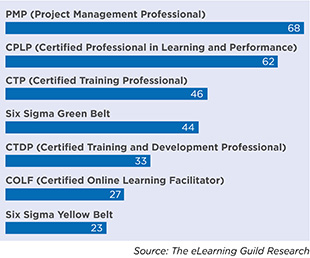
Figure 2: Professional certifications held by largest numbers of 2017respondents
Comparison of US degree holders with and without professionalcertification
In comparingdegree-and-certificate holders with those who hold degrees only (Table 1), we sawthat those holding both a bachelor’sdegree and a certification earned an average salary that was 7.81% higher thanthose holding only a bachelor’s degree.
Similarly, thoseholding both a master’s degree and a certification earned an average salarythat was 2.88% higher than those holding only a master’s degree. Because of lowresponse rates for other education levels and for those who said they held botha degree and a certification, we reported comparison data only for bachelor’sand master’s degrees.
Table 1: Average salaries for US degree holders with and without certification | ||||
| Without Certification | With Certification | Percent Difference With Certification | ||
Bachelor’s degree | $79,032 | $85,204 | +7.81% | |
Master’s degree | $83,603 | $86,011 | +2.88% | |
Itis clear that advanced degrees and professional certifications can enhanceopportunities for eLearning professionals to advance in their field and earn anoptimal wage. But how can they best use this information to help in individualcareer and compensation planning?
Taking action on 2017 education and certification data
In2015, we introduced a new section of the annual report called “Taking Action onThis Year’s Salary Data.” This was done in an effort to provide actionable,practical suggestions for utilizing the data provided in the report.
In2016 and again this year, we updated this information with current referencesand additional guidance that should enable you to go beyond just reviewing thesalary findings in this report and developing your own salary action plan. Thefirst step in this process is a self-appraisal of your salary negotiationknowledge and skills, as well as a self-appraisal of your current compensationplans and goals.
Youcan utilize the education and professional certification data summarized inthis article, supplemented with more information from the 2017 salary report. Youcan do this by using a tool to evaluate where you stand in terms of the costsand benefits associated with a degree or professional certification.
Inthis year’s report, we provide information and tools (“planning worksheets”) thatenable you to calculate benchmark salaries for a number of differentcompensation planning scenarios. Instructions for filling out the worksheet canbe found in Appendix 4 of the salary report, and are briefly summarized asfollows:
- For each US compensationvariable shown in Table 2 (below): Calculate the percentage change between the2017 US average base salary ($83,139) and the salary average taken from theappropriate data source diagram, and insert the resulting percentage change (apositive amount for an increase, or a negative amount for a decrease) into thatline item on the worksheet.
- Repeat for all compensationvariables in Table 2 until the top section of the worksheet is complete.
- Calculate the total of all of the percentagechange amounts (positive and negative values) and enter this percentage intothe worksheet (Table 2). Percentage change values shown are examples only.
Followingis a sample compensation scenario and planning worksheet (Table 2) that focuseson the costs and benefits of obtaining an advanced degree. This same planningscenario could also be modified to focus on the value of obtaining an advanceddegree in addition to a professional certification.
Sample scenario: Instructional designer determining the value ofa master’s degree
Renee is aninstructional designer working for a federal government agency with 3,200employees in California’s San Francisco Bay Area. She has eight years ofexperience in her current position and more than 10 years of experience in theeLearning field.
Her agency likes to promotepeople with good skills and master’s degrees. Therefore, Renee has worked hardto complete her bachelor’s degree recently and has already started saving moneyfor a two-year master’s degree program.
However, Renee wonders if the salary difference is really worthall the extra effort and money she would need to invest. Her current salary is$87,452. Philip, her supervisor, has been encouraging her to move forward withher plans for graduate school and has explained that their company has atuition reimbursement program that will cover part of Renee’s tuition andbooks. He is also willing to adjust her work schedule so that she has moreflexibility to attend daytime classes.
Note: The figures referenced in the “Data Sources” column (Table2 below) appear in the 2017 eLearning Salary and Compensation Report.Please see the report for the figures that provide these data, and use thefigures to calculate your own values for the “Adjustments” column(s).
Table2: Samplecompensation planning worksheet | |||
US Compensation Variables | Data Sources | Current Adjustments | Adjustments with Master’s Degree |
Location
| Figure 4: US average salary by employer metropolitan area | +28.12 | +28.12 |
Industry
| Figure 6: US average salary by industry | +7.75 | +7.75 |
Company size
| Figure 7: US average salary by company size | -3.67 | -3.67 |
Number of people managed
| Figure 8: US average salary by number of people managed | -7.98 | -7.98 |
Education level
| Figure 11: US average salary by education level | -2.78 | +1.41 |
Job focus area
| Figure 13: US average salary by job focus area | -5.38 | -5.38 |
Time in position
| Figure 10: US average salary by time in position | +6.26 | +6.26 |
| Total percentage adjustments | +22.32% | +26.51% |
Average US base salary | $83,139 | $83,139 | |
Total dollar adjustments | +$18,557 | +$22,040 | |
Benchmark annual salary | $101,696 | $105,179 | |
Investing time,money, and effort in earning her master’s degree could enable Renee tonegotiate a substantial increase of about 20% from her current salary of$87,452, to a benchmark salary (with master’s degree) of $105,179. In fact,this exercise reveals that she may be able to negotiate a raise even without earninganother degree, as her current benchmark (with a bachelor’s degree) is actuallycalculated at $101,696—only 3.31% lower than the benchmark amount with amaster’s degree.
However, a postgraduatedegree would give Renee a number of other long-term advantages andopportunities that she might not have now. For example:
- She may want to stay in the San Francisco metropolitan area,move elsewhere within California, or even look for other jobs in the PacificNorthwest. An advanced degree would give her additional job leverage over justa bachelor’s degree if she wants to relocate.
- Having a graduate degree would likely increase her opportunitiesfor higher-level jobs with people-management responsibilities thatsignificantly impact base salary.
- In addition, a graduate degree may increase Renee’s interest inmoving into job focus areas with higher average base salaries than that of aninstructional designer.
- Finally, given our data on the wage benefits of combining aprofessional certification with an advanced degree, Renee may also want toconsider obtaining a certification in conjunction with (or before) working onher master’s degree.
Conclusion
Obviously, there are many complexfactors—in addition to education level and professional certification credentials—thatcome into play when benchmarking 2017 compensation scenarios.
Our goal in this article, as withthe entire 2017 salary and compensation report, is to provide practical toolsand current, comprehensive, and relevant information in order to help eLearningprofessionals build their knowledge and take effective action on theirindividual salary plans.
References
ProjectManagement Institute (PMI). Earning Power: Project Management Salary Survey, ninth edition. 2015.
Robo, Regina. “Eight Things That Can Boost Your Pay.” Salary.com.
Vipond, Sharon, and Temple Smolen. 2017 eLearning Salary & Compensation Report. TheeLearning Guild, 2017.