Developing a learning data strategy is all aboutthe outcomes. It’s about the change that will happen in your organization as aresult of design decisions that you implement for puttingdata to work. The best way to create a learning data strategy is tothink about not only what you have today, but to focus on where you want to goand what it is that you want your learners, managers, and stakeholders to beable to learn from and to do with data you make available to them.
In the following article, explore themethodology organizations are using to strategically connect their investmentsin learning data to business outcomes with a sustainable, future-forwardapproach.
Planning:The foundation for a successful data strategy
As with any successful strategy, the planningand research phase is the most important part. When it comes to designing alearning data strategy, organizations are working through planning as a four-stepprocess—preparation, evaluation, evidence, and presentation.
- Preparation. The first stage issimple. Look around your organization and take inventory of all the tools,spreadsheets, rosters, platforms, and any other possibledata sets that you already have in your learning ecosystem. Aim toanswer the question “What data do wehave?”
- Evaluation. Once you know what youhave, you then need to evaluate the quality, usefulness, and impact of thosedata assets. This will allow you to build a solid understanding of the value ofwhat you have, why you like what you like, and what you think needs to go. Fromthis stage, you’ll be able to define “Howdo we use our data now?”
- Evidence. Now that you’veevaluated the value of the learning data sources you already have, you’re ableto start mapping out the availability of data as they relate to yourorganizational goals. During the evidence stage, define your critical questionsor business objectives, work to identify the data that helps you answer thosequestions, and, if you can’t answer all of your questions, identify new dataassets you’ll need to fill in the gaps. Here you’ll determine “What do we want to do with our data in thefuture that we can’t do now?”
- Presentation. If you’re going tomake your data useful and strategically connected to the organization, you haveto determine how to surface it to the right people in the most effective way.In this stage, you’ll need to determine how, where, and at what level you wantyour stakeholders and learners to be able to access information relevant totheir needs. Don’t overlook this critical step. Identify and plan to have ananswer for “How will each stakeholder inmy organization put learning data to work daily?”
If you’re interested in seeing more bestpractices for planning and lessons learned, check out this Learning Data Strategy Workbook orthese resources from SAS and O’Reilly that look at enterprisedata strategy development. The latter two are not scoped specifically tolearning data but provide excellent guidance and best practices fromapplication in IT departments.
Implementation:Turning data strategy into reality
While the planning phase of a learning datastrategy is always personalized to the organization, implementation can useout-of-the-box technologies, custom solutions, or some combination of both. Agood place to start is to choose one or two well-defined business objectivesthat you focused on in the planning phase. From your data strategy planning,you should knowwhat data assets you have that will support those businessobjectives. During implementation, your focus will be first on unifying therelevant data assets in interoperable formats, such as xAPI, and a central datastore, such as a learning record store. If your data is not already in aninteroperable format, you may need to complete xAPI integrations or datatransformation processes to get your data in interoperable formats.
After your data is unified and standardized, youcan begin to implement the presentation stage of your learning data strategy.Whether your organization is working with out-of-the-box business intelligencetools or designing custom dashboards and data visualizations, it’s critical toconnect the existence of the data to the ability for stakeholders to apply thedata.
Forthe learning and development team
Let’s look at a situation where an organizationdecided that one of their business goals for implementing a learning datastrategy was to optimize their investment in a modular, modern learningecosystem. Specifically, the organization had invested in several differentlearning platforms in order to provide a variety of learning resources andformats to their employees including an LMS, a learning experience platform,intranet, and discussion forums. However, the organization did not have accessto analytics that provided transparency into if, when, and how their employeeswere engaging with the various learning platforms. By developing a datastrategy that tied the investments they had made to the change they wanted tosee, the organization was able to use a specific set of success metrics tounderstand and optimize platform adoption over time.
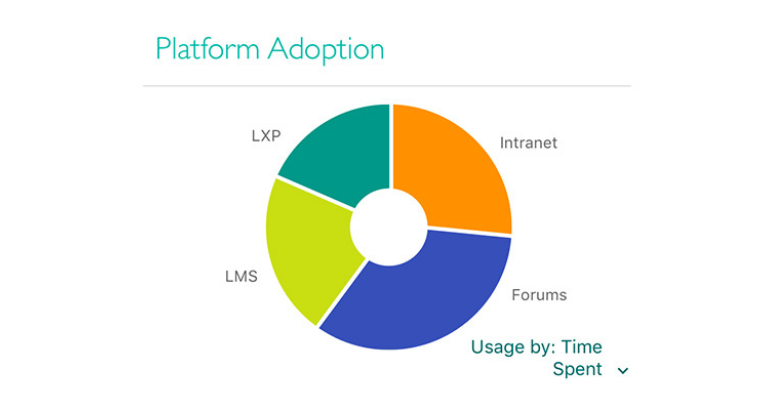
The following visualization examples (Figures 1through 4) illustrate how the organization presented this unified data to theirstakeholders.
Figure 1: This platform adoptiondata visualization illustrates adoption of each platform based on how much timeemployees spent engaging with content on the platform. The data card can beconfigured to illustrate adoption based on activity on the platform, as well astime spent.
Figure 2: This timeline datavisualization illustrates learning activity on each platform over time,aggregated from across a group of learners
Figure 3: The platformcalculator enables the stakeholder to monitor the actual adoption rate and costper user based on near-real-time utilization counts
Figure 4: The activity hotspots datavisualization illustrates when and how much employees are engaging with eachplatform in the learning ecosystem
With this kind of information readily availablein near-real-time, the organization was able to sunset platforms that weren’tproducing results, incentivize employee utilization of effective learningplatforms and provide data-driven business cases for platform investment at theexecutive level.
Forlearners and other stakeholders
Once data is collected and understood at theaggregate level by the L&D team, many organizations will take the next stepby making that data accessible to managers or individual learners directly.This most often will take the form of individualized data dashboards that havebeen scoped directly to the learner, manager, or executive using thepermissioning structure from the organization’s single-sign-on system (Figure5).
Figure 5: Creating a dashboardof visualizations that enable individual learners to see their own learningdata can help them understand how they compare to their peers and theexpectations for their role
By unlocking this level of data transparencythrough data visualization access directly to learners, organizations are ableto significantly improve learner agency while increasing the rate and frequencyof assignment completion. Managers are able to use near-real-time data on adaily basis to make interventions with direct reports, saving time, money, andheadaches. Empowering learners and managers directly with learning datadistributes accountability for effective talent development across all levelsof the organization.
One important consideration in the effort toshare learning data at all levels of the organization is the benefits that cancome from a metered cascade of dashboard access. It can be quite effective tostart by surfacing learning analytics at the administrative and executivelevels first, then opening access to managers, and finally to individuallearners. Through this metered approach, you will be able to demonstrate thevalue of your data strategy as early as possible to key stakeholders andexecutives, while allowing you to build internal subject matter experts anddata evangelists, all of which will help you drive adoption and buy-in to yourlearning data strategy across the organization.
Evolution:Sustaining your data-driven learning ecosystem
Designing and implementing a data strategy isnot a one-time effort. Just as the needs and goals of an organization changeover time, so will the learning technologies available to you and theexpectations of your workforce. Once you’ve implemented your learning datastrategy and experienced the impact of the resulting data-driven outcomes, it’stime to develop an ongoing maintenance and enhancement plan that will ensureyou evolve your learning data strategy alongside your evolving organization.
Here are some key items to consider as youevolve your learning data strategy:
- Revisit your strategic plan annually. Thegoals of your organization, and the resulting learning and developmentobjectives, will change over time. A best practice is to evaluate your learningdata strategy annually to ensure that the data assets you’re gathering and thesuccess metrics you’re monitoring remain closely aligned to your currentbusiness goals. Including your IT and finance partners in this review processcan help secure the appropriate resources to keep implementation needs up todate with your strategic plan.
- Evaluate emerging technologies. Theavailability and accessibility of new learning technologies improvesconstantly. Just think how far virtual reality technology has come in terms ofbecoming a standard part of the instructional designer’s toolkit! Stayingapprised of emerging technologies is an important part of a learning anddevelopment professional’s responsibilities. But not every technology is goingto suit the learning needs of your organization. Pilot testing a new technologycan be a great way to assess fit with your organization. Defining the successmetrics associated with the pilot test and building real time data flows fromthe new technology into your existing set of performance metrics will help youquickly determine value to your organization and build a data-driven businesscase for further investment.
- Optimize platform adoption and effectiveness.Optimization of learning platforms, and the associated investment, is also anongoing effort. At least annually you should evaluate how each platform iscontributing to learning engagement and business outcomes, assess currenttechnologies against emerging technologies, and analyze your cost and ROI oneach platform. The results of this assessment may alter specific successmeasures you have in place for each individual platform and/or the successmetrics you are measuring across the entire ecosystem.
- Make a plan to implement advanced analytics.Through the implementation of your data strategy you will have created a poolof unified, standardized xAPI data. This pool of high resolution, time seriesevent data represents a tremendous asset to your organization. As you gathermore and more data over time, the value of that data only increases. A rich,relevant, and maintained data set enables advanced analytical functions andtools such as recommendation engines and predictive analytics. For an L&Dprofessional, this can mean providing automated and personalized learningcurriculums for your employees, or the ability to identify high performers whocan be funneled into advanced leadership training, or even using smartanalytics to more quickly identify employees experiencing performance declinesand implement interventions earlier and more effectively. When you build asolid learning ecosystem foundation through a well-planned data strategy, thepossibilities are powerful.
Just as every learner is unique, every organization isunique. From business goals to culture to the way employees like to worktogether, our job in learning and development is to take that uniqueness andtranslate it into learning experiences that drive business results. Which meansthat the process you use to develop your learning data strategy must tap intoand be customized to that uniqueness. If you build your learning data strategywith a well-designed plan, implement piece-by-piece, and continue to evolve,you’ll be putting data to work for learners, managers, and executives each andevery day.