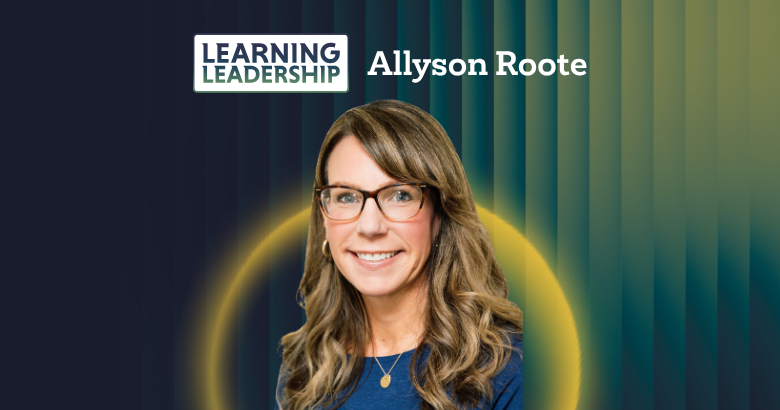
Over the past 25 years, Allyson Roote has witnessed the evolution of learning and development from a focus on content creation to a strategic business function. As VP of Learning and Organizational Development at The Bonadio Group, she leads learning initiatives that support leadership development, organizational growth, and business performance.
At Learning Leadership 2026, Roote will share how learning leaders can turn one of their most challenging moments—being left out of a key conversation—into an opportunity to build influence. Ahead of the event, we spoke with her about the shifting role of learning leaders, navigating change, and why curiosity often matters and can help you get a seat at the table.
Q: How did you get your start in learning and development?
A: I’ve been in learning and development about 25 years now. I started when I actually worked with an executive coach and I loved the work that she was doing. Long story short, I immersed myself in everything that I could in terms of research and educating myself on coaching, learning and development, and human resources. I did a few internships at the time and then landed a position as a learning specialist. Then, I pursued my master’s in human resource development with a focus in learning and development while I was starting my first position as a learning specialist. It’s kind of come full circle because last year I finished my coaching certification program and I’m sitting for the exam next month. So, it’s been a wild ride over 25 years, but I’m actually excited to get my coaching certification and kind of come full circle with everything that I’ve done thus far in learning and development and get back to where I started with coaching.
Q: What does your current role today look like?
A: I’ve been in my role for about 10 years now. I work for the Bonadio Group, a top 40 accounting firm nationally. I report directly to the COO and have a team of nine individuals who support the learning function across the firm, whereas I was one person that started in this role 10 years ago. So, I’ve seen a ton of transformation over the years. And I’m really proud of where we’re at. We focus a lot on strategy and making sure that we’re aligned with where the firm is going and how we’re evolving as a learning and development team alongside what’s happening at the firm.
Right now, I’m restructuring my team to really focus on two different areas of learning and development, one design and experience and one operations and analytics. We’ve grown so much organically over the years that it got to the point where everyone was reporting directly to me. And that worked when we were smaller, but as we grew, it just didn’t work or provide the support that the firm needed. So I’ve done a lot of work around developing frameworks and programs around leadership development and supporting our leadership pipeline. I do a lot of work to support learning at the executive level.
It’s just a great firm to work with. I feel real, truly feel supported by the firm and the people that are here and how our learning is really embedded in our strategic plan. It’s not something nice to have, but it is truly part of how we operate and drive performance at the firm.
Q: What would you say has changed most about being a learning leader in recent years?
A: I think having been in learning and development for so long now, at that point in time. When I was just starting out as a learning specialist, it was about creating catalogs and courses and filling pages with all of this great content. That has really shifted and changed over the years and shifted my thinking too in terms of what’s most important. I talk to my team about this consultative approach that we need to take, not just like we would be in manufacturing, so to speak, like input output, but really an opportunity to consult with the business, to consult with key stakeholders, to really define what the problem is.
Including focusing on diagnosis over delivery versus just handing someone a curriculum and hoping for the best. So, I think the biggest change is just the fact that we’re moving away from just pushing out curriculum all the time to really focusing on what is the impact overall that we can have to the business that we’re operating in.
Q: Can you give a sneak peek into the discussion you’ll be leading at Learning Leadership 2026?
A: I’m going to dive into some scenarios, and one in particular that was a moment that could have gone really wrong. It’s about a situation where a program had been fully developed without learning and development at the table or as part of the conversation and how you need to shift your entry point when something like that is found out or lands in your lap. So, instead of leading with critique and defending why L&D should have been there, it’s about leaning in with curiosity.
I have kind of a framework in my own mind that I’ve developed to work through this. And I think it really helps to identify, you know, where L&D can get things wrong versus taking a step back and really focusing on how we can approach the situation in a way that will be the most meaningful and impactful to the business. I’m going to walk through all of that, but I’m really looking forward to hearing what others are experiencing too, and how this lands with them in terms of not having a seat at the table right away, but then being invited to the conversation and what their entry points are.
Q: What is something that you hope attendees take away from the conversation?
A: I really want them to be able to reframe that moment that they get left out of something, because that’s exactly what I had to do. I think our instinct is to defend our turf, which is, I think, completely natural, but it is also something that can cost you your influence. So, I want people to leave with
permission to ask the question instead of feeling as though they have to prove their right to be in the room.
Q: What are you personally most looking forward to about the event, about Learning Leadership 2026?
A: I love that there is a focus on the fact that this is for learning leaders. I think really connecting with the people, obviously hearing from other speakers and learning from them. I think this is a unique conference in that other conferences focus on a wide variety of different areas of learning and development, instructional design, technology, the programs themselves. But I think that this focus
on learning leadership allows individuals to come together and really connect with people that are going through similar situations and how we can establish best practices and benchmarks for me and learn from each other.