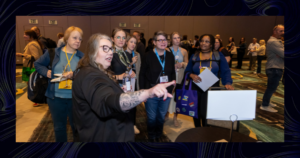
Followinga great week in San Jose at mLearnCon, where for two and a half daysI was the host of the Mobile Operating System Help Stage (MOSHPit), Inow have had some time in the wine country in California and back inLondon to reflect on what we did, who we met, and the importantconversations that took place.
Ialmost did as others have done and wrote an article the followingday, but instead I shrugged off the urge. By allowing time for Kolb’sExperiential Cycle to work and to let the whole overpowering weeksettle, I now have some sense of what took place.
Asone of the “experts” at mLearnCon I was motivated to find outwhere delegates are in the cycle to adopt learning to mobile devices.As “The Learning Coach,” I was also readily available to enterinto discussion about not only how to implement learning to themobile device but what to deliver, and to pose questions to manylike, “Why are you doing this?” and, “What are you expecting?”
Iam conscious that over the last 20-years of eLearning, the technologyside of the industry has been led by (a) the vendor, (b) the contentas reflected by the Authoring Tool’s ability to create learning,and (c) the LMS’s ability to deliver it. This is different from thestrategy to deliver good learning modules and courses designed aroundgreat learning outcomes rather than some off the shelf template,masquerading as bespoke content.
Ihave in those 20 years watched four boom-and-bust cycles ineLearning. These were:
- The high-cost outsourcing model,
- The DIY (Do-It-Yourself) Model,
- The “offshore” model, and more recently,
- The Rapid Model.
Nowcomes Generation 5, the Mobile Model.
Twoof these cycles were quite obviously DIY. These have always been thecenter of conversations that include a phrase similar to, “Well, ofcourse ours never quite looks as good as the one created for us” –and then I ask, “Why not?” The answer often blames the authoringtool or the person creating the content. Of course, the personcreating the content has probably never had media training, or realtraining in Instructional Design. Plus, of course, the authorprobably has another full time job in the organization. Yadda, yadda,yadda. I would love to have a dollar for every time I had thisconversation.
Soit was with some trepidation that I took a while to walk around theExpo of 25 suppliers peddling their wares. I was somewhat concernedthat a few were the same vendors we see at other shows for eLearning.Same tools, smaller template! I asked whether this was the right toolfor the job, is this what we are actually trying to do? The expertssaid no! The tool vendors said: “Buy my product; it’s thefastest, and the greatest.” Oh-oh, here we go again.
ButI am also pleased to report that not all the vendors had the samemessage, nor were all peddling the idea that mLearning is aminiaturization of eLearning. Still, for some partygoers, it wasquite obvious this was the underlying consideration.
Sowhat did we learn at mLearnCon? Well, thanks go to a very lively chapI met called Alvin, who took me by surprise when I questioned himabout why he wanted to deliver all of his eLearning shrunk onto amobile. “I work with a large group of Gen Y’s, and that’s whatthey want. It’s their device, it’s what they know how to use,it’s in the format they want, and it’s in their pocket, notmine.” Thank you, Alvin! This started the session with a big bang,and the whole group listening started to talk in a different way andstarted to think about possibilities they had not thought aboutbefore.
This wasthe theme of two-and-a-half days: discover what you had notpreviously considered. For many, the question was, “WebApp orNative?” For others, it was, “HTML5 (“Whatever that may be,”said one person) or Flash.” That latter discussion in the MOSHPitdrew a crowd too large to count; the argument will continue for along time to come, I am sure.
Forme personally, I learned we as the “experts” have to spend muchmore time explaining what you can do with the mobile device. My chatswith Judy Brown, which involved much heated conversation and muchlaughter as we completely disagree on what actually constitutes amobile device, will continue for some time. For Judy, the mobiledevice must fit in a pocket. For me the device just needs to not betied to the desk or run from a power outlet.
Inthe week in San Jose there were so many conversations I lost count.Some were with people who were physically at the event. These tookplace over some great meals and in numerous places that plied us withcopious quantities of liquid we would never consume at home. Otherconversations engaged individuals who were following mLearnCon fromevery corner of the world, via a plethora of social media tools.
Theinteresting point is that everything we learned was in a conversationof one type or another. Thankfully this underpins my concept that thebest learning method is still conversation. We need to talk.