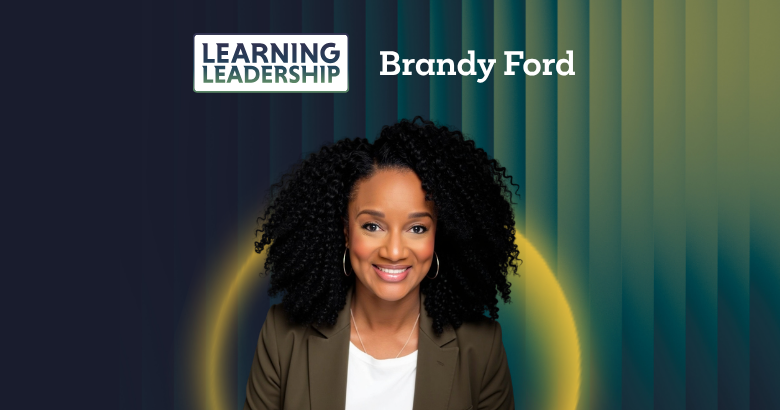
Learning leaders are navigating rapid changes in business needs, technology, and workforce skills. And keeping pace requires staying closely connected to the organization. With more than 20 years of experience in learning and development, Brandy Ford has seen that evolution firsthand. As Head of Learning Analytics and Technology at FM, she oversees learning strategy, analytics, and the technology that supports the organization’s global learning culture.
In this interview, Ford discusses the importance of measuring learning’s impact, maintaining strong relationships with stakeholders, and building a future-ready learning ecosystem. She also offers a preview of the practical conversations and solutions she hopes leaders will take away from Learning Leadership.
Q: Can you tell us a little bit about how you got your start in learning and development?
A: My start in learning and development is around 23 years ago. I worked in healthcare insurance and I was part of the training team and loved everything about it. They were like, hey, you have a big, bright personality. Would you like to train and help teach people and onboard them? And I was like, sure, it seems like a lot of fun. I love people and I love learning. So it was a great fit. I loved everything about it!
Q: What does your current role look like, and what’s your favorite part?
A: My current role, I oversee monitoring of our overall strategy within our learning and development space. I oversee our learning analytics and also technology. And so that is a big pool of work, but it’s probably the best and the funnest pool of work. As I look at the data, as I collect the data, as I analyze the data, and then be able to report back on that, it allows us to know and understand if our training and learning is actually effective. Does it bring impact to the organization? And that’s something that our CEO would like to see. I don’t have the ask or the concerns about, is it giving us a return on our investment? They really want to know what impact is it bringing and is it actually effective? The other part of that is the technology that it takes for us to be able to create and deliver our learning. Our organization is such a huge learning organization and we have a large learning culture. Everything that we do here at FM is surrounded about learning, whether it’s our technology, whether it’s our research campus, whether it’s how we fly our employees from all over the world to our learning centers. We have one in Norwood. We have one in Singapore. We’re building one right now in Luxembourg. And so to put that amount of effort, emphasis, and dollars into learning says a lot about our organization. So, because I get to look at the technology that makes us the most effective, that makes us the most efficient. And also it keeps us in the loop of having the latest and the greatest of what we need to produce the type of learning that we need to make sure that it’s interactive, that it’s engaging, that it’s purposeful. So I love the technology piece and working with all of our vendors to ensure that we have the right tools to create and deliver our learning.
Q: In your opinion, would you say has changed most about being a learning leader in recent years?
A: It’s all changed because the world is changing, right? The business need is changing. The business requirements are changing. It’s all changing. We are in probably one of the fastest moving change models that anyone could feel. All of my counterparts who talk about it all the time, even as a change leader, the amount, the rate of change, all the areas of impact that change is hitting. I think the rapid speed and the rate that we are changing, it makes everything move at a different pace rate. So even when we talk about putting a strategy in place, our organization might put a three-year strategy in place. By the end of year one, we’ve already had to kind of move and massage that because now the ask is looking different because we have to keep up with the pace of what the business is needing. We have to keep up with the pace with how we’re reading the data and what is telling us. We have to keep up with the pace. Are we analyzing this data properly? And then are we reporting out on it so that we can see where the areas of need are in the quickest form and fashion. And then also because technology is moving in the way that it is moving, are we able to keep up with the demand of that along with the learning actual need to get people where they need to be? And I think that is changing so much year after year. I think I was in a group of leaders who are in HR, and right now, within the HR space, they’re stating that skills are changing every 30 months. How can organizations keep up with that? And that is keeping, literally having to keep your finger on the pulse, but also staying next to connecting with the business so often that you’re not being called in and caught off guard when things are coming down the pipe or there’s a pivot or there’s a change. So I think the biggest change is how close are you with the stakeholders? Are you meeting with your stakeholders regularly? I’m not talking about monthly, quarterly. I’m talking about sometimes it needs to be weekly so you can really understand and really keep your finger on the pulse. And I think that’s the biggest thing right now with the amount of change, keeping your finger on the pulse and making sure you are right alongside all of your stakeholders so you really understand what the needs are and how they’re changing quickly.
Q: Can you give a sneak peek into the discussion you’re going to be leading at Learning Leadership?
A: When you are defining a future-ready learning ecosystem, you have to think about what you’re trying to accomplish in your organization, right? We have an organization of around 6,000. My counterparts have 25,000, 35,000, 100 and something thousand people that they have to deliver training for. So, when you’re talking about an ecosystem, a lot of times when we go after technology, we just say, oh, that looks good. It’s shiny. Like, let’s bring that on. But does it really work for an ecosystem? Yes, you need an LMS, but then, okay, well, Brandy, I don’t have the budget to get the LMS that I need. And then I have workday and then I have, you know, all these things, but they really don’t talk to each other. So now I messed up because now I got to go to each piece and do something differently. When you’re thinking about constructing like your plan of how you’re going to be future ready for the number of people who have to come through learning, for the number of people who have to come through development, you have to think about what technology stack. Is it going to work for everything to work together seamlessly so you don’t have to piecemeal every 5 minutes? And then you’re working with a ton of vendor partners. IT is like scratching their head every five seconds trying to figure out, oh shoot, how do we troubleshoot for this? How do we do this? Now you’re not rolling off contracts because, okay, well, that didn’t work. So let me just pick this up over here. Okay, well, that didn’t really work either. So what is the actual plan? What is your roadmap look like? Have you done this sense of research? What is your governance when it comes to selection and analysis and actually implementation, you know, thinking about all those things like that and putting the right pieces together. Some people say, well, Brandy, I don’t have time. Well, if you don’t have time, that’s when you hiccup and you mess up and it will cost you more. So even if you’re given just a little bit more time, you put the right project plan together, you put the right governance structure together, that’s where you’ll get to the right ecosystem that will support the work that you need to get done for an extended period of time. At least you’ll have a five year, six year, seven year run instead of every year, every two years, you are having to switch out because those pieces don’t work together. Your APIs are not connecting properly. The technologies that you bring in don’t speak well together and you’re still not getting what it is that you want. So I think when we talk about this, one, what is the overall objective? And 2, what are the right pieces to put together? What is your selection process going to look like? What is the governance of that going to look like? And then sit down and with whoever the group decision makers are, this is what we have. These are our pros and cons. This is what’s going to get us there. Do we have the budget for it? Do we have the buy-in for it? And do you agree to this plan? And I think that would get us a lot further than where we are, always cutting things off, bringing things on, and then having low adoption rates, low utilization, and different things like that.
Q: What are you most excited about for Learning Leadership at the event?
A: I’m excited about the leaders that are coming. I’m excited about the exchange of information that’s going to happen. I’m excited about the challenges that everyone is facing and trying to really find the solutions of how do I do this. And I really feel like the leaders that are going to come and show up, they’re going to leave with something, nothing empty, nothing like, oh, well, I heard a whole bunch of words, but I didn’t get to take anything back. But I really believe that people are going to be able to get tangible things that they can go back to their offices and they can start sparking and going to work.