There are people who invent useful and profitable products,and there are people who perform the manufacturing, distribution, and record-keepingrelated to those products. Once these operations and the personnel required tomanage them grow in complexity, so does the chance of losing the vital organizationalknowledge associated with core knowledge and processes. This was the case witha small manufacturing company that enlisted the help of IQStrategix to recaptureits corporate knowledge.
It does not matter if an organization is large or small; theIQStrategix process of identifying and retrieving vital organizationalknowledge buried deep within organizational structures is the same. Thedifferences between a small and large knowledge base and its eLearningfunctions are simply the number and complexity of those structures, and thusthe time and effort it takes to successfully regain knowledge control.
What makes the following project interesting is that, inaddition to the knowledge recovery process, IQStrategix’s team also taught the companymanager the art and science of knowledge engineering. Her mastery of thediscipline went from zero to accomplished as she worked part-time on theproject until it was completed. She now maintains and advances her company’s knowledgeecosystem without outside help.
IQxCloud use case: Background
“ABC Manufacturing” is a small manufacturing company thatprovides products to a niche customer base. (I changed the company’s name inthis article to protect its identity, due to the sensitivity of its market.)ABC is a family–owned and operated company that has been in business for manyyears. Like most small manufacturing companies, there has been little turnover amongits managers and employees over the life of the business.
ABC owns and operates numerous special-purpose machines, itbuys its manufacturing materials and supplies from regional vendors, and it farmsout specialized fused-part processing to ISO-certified subcontractors. Theoperation runs smoothly, yet management felt there was a deep threat looming onthe horizon because ABC’s chief machinist, who has most of the manufacturingprocesses in his brain, was getting older and had some minor medical problems.
ABC’s manager also realized that there was a deep reservoirof “production knowledge” she did not know or understand, making it unlikely thatshe would be able to successfully hire and train a new machinist to run themanufacturing side of the business in the event her chief machinist left thecompany. This knowledge deficit problem presented a hidden threat to the familybusiness, just as it does to tens of thousands of manufacturers around theworld who are faced with the same situation regardless of their size andstaffing.
IQxCloud knowledge engineering content curation process
After the initial introduction and engagement process,IQStrategix’s Martha Nawrocki was flown in to assess the knowledge deficit problemby defining the scope and recovery process for the project. Martha firstunderstood how the management, marketing, and manufacturing efforts functionedtogether; then, she focused on the manufacturing of ABC’s 63 products. Duringthis process, she learned that the manufacturing process required 6 – 12 proceduralsteps for each part.
Other information requirements were:
- Number ofmachines—14
- Documentation—Mostof the machine settings and procedures used by the machinist were recalled fromhis memory as they were required. Available documentation was over 20 years oldwith hand-written annotations on tolerance settings, which had to be verifiedfor accuracy against current requirements. The production process included orderingbase materials from suppliers, multiple in-house machine processing steps, outsourcingspecialized production processes to third parties, staff quality controlinspections for each major step, and inventory control for finished products.
- Operatingand maintenance manuals—There were only six machine manuals in-house. Therest had to be located on the Internet and uploaded to the knowledge ecosystem.
As Martha and ABC’s manager reviewed the resource materials,the importance of restoring the company’s lost knowledge became obvious—losethe machinist, lose the company. ABC’s manager immediately went to work on thefile cabinet, updating and digitizing the product production procedures. Sheused Excel files to organize required resources. The manager then “interviewed”her machinist. Rather than just asking questions, she documented every step hetook in the setup and manufacturing of each machine and part while in production.
Working remotely, Martha then helped ABC’s manager toidentify other areas that needed documentation. These included:
- ManagementResource Cluster—Strategic planning and annual production planning, accounting,asset identification, and the reordering of ABC’s digital and hard copylibrary.
- MarketingResource Cluster—Customer sales procedures, customer/product identification,and product shipping and handling sequences (worldwide).
- ManufacturingResource Cluster—Set of suppliers, in-house machines (manuals, identity, andfunctions), repair and maintenance vendors, machinist tasks, manufacturing staffoperations, and molds.
During the discovery process, Martha also learned that, forthe most part, ABC’s manufacturing and quality assurance standards andprocedures complied with ISO (International Standards Organization) standards, butthe company had not sufficiently gathered and recorded this information to proveits processes and procedures as required for ISO certification. It was clear toMartha that by digitizing the content and procedures, a major part of ABC’s knowledgereclamation goal could be met and ISO certification obtained, though notcurrently required.
IQStrategix organizational front office modeling solution
As the ABC project illustrates, organizational knowledge isdeeply intertwined. Discrete processes and procedures related to one departmentor operational function usually cross the lines to another department orfunction as illustrated herein: management, marketing, sales, customerrelations, accounting, and manufacturing.
Given this, front office processes and procedure activities needto be aligned with back-end processes and procedures to achieve the greatestvalue from organizational structures. This is especially true since it is theseprocesses that can easily impact the profitability of a business.
ABC’s wholesale customer sales procedure, for example,includes counseling customers on which products might be best suited for their markets.This single procedure was easily conducted by the office manager, given heryears of experience, but it would be very difficult for a new person to performthe same function if they lacked the office manager’s depth of knowledge aboutABC products. The complexity of the product identification process would simplybe too overwhelming for a new person to discuss in a normal, free-flow salesconversation.
After automating the product identification procedure inIQxCloud, the product sort-and-recommend function could walk a new personthrough a step-by-step procedure that is both intuitive and effective. It alsoprovides a “what-if” capability that identifies related applications for aselected product, which could lead to greater sales of ABC’s products. A hiddenadvantage of the real-time product sort-and-find process is that a new personcould easily conduct an ordering process more professionally and accurately thanif he or she were using the previous manual system. Other similar processes andfunctions were also modeled as illustrated in Figures 1 – 4, which togethercompose the ABC Knowledge Ecosystem Modeler’s Map.

Figure 1: Overview of the ABC Manufacturing Knowledge Ecosystem

Figure 2: The ABC Management Cluster
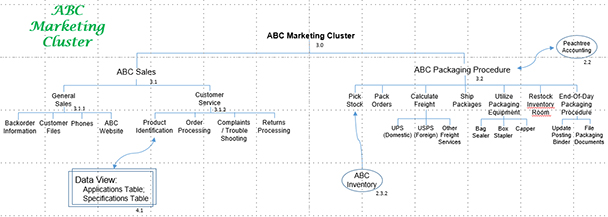
Figure 3: The ABC Marketing Cluster

Figure 4: The ABC Manufacturing Cluster
The IQxCloud knowledge ecosystem development solution
The knowledge ecosystem development process proceeded asfollows:
- ABC’s manager provided the digitized sourcematerials for the project, such as product pictures, schematics, tolerances,operating and maintenance manuals, videos, and other production materialsincluded in the ABC project. She also developed over 20 standard operatingprocedures for her office staff—rounding out the knowledge she wished toinclude in the ABC knowledge ecosystem.
- Martha identified all of the required rational patternsof thought (processes and procedures), which could then be modeled ascompositions, taxonomies, sequences, sets, and so forth. These were outlined ina Word file. The IQxCloud model approach, used throughout the knowledge ecosystem,provides a natural consistency of presentation that is both rational and user-friendly.
- All the words, phrases, and symbols used inABC’s business were listed in an Excel spreadsheet, defined with descriptors todisambiguate same spelling and heterogeneous terms. No concept model ordocument is ever duplicated.
- The list of Excel concepts was then uploadedinto IQxCloud using the systems’ “FastEdit” function.
- The Word model outline was then uploaded intothe IQxCloud “Builder” component, which immediately populated a set of buttonsin what is called the “Rational View,” a functional view of the IQxCloud browsercomponent. There are several views, however; the Rational View is one of themost used interface views. A small fragment of the Rational View screen is shownin Figure 5.
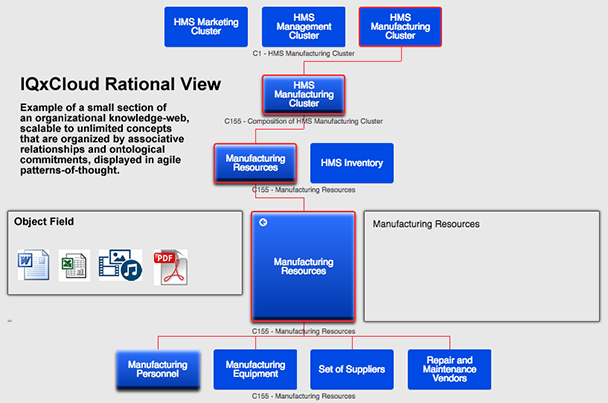
Figure 5: Rational View
Seen from a detailed concept perspective, the IQxCloud back endorganizes concepts based on their associative relationships as opposed toconventional structured indexing. As a result, users can click from one conceptto another throughout the knowledge ecosystem. See Figures 6 and 7.

Figure 6: OrganizationalKnowledge Ecosystem

Figure 7: Concept detail of organizational knowledge ecosystem
Conclusion
ABC Manufacturing’s primary goal was to recover its operation’slost knowledge. In the end, the company not only regained the knowledge it hadlost, but it also gained a real-time eLearning environment that novice userscould access to rapidly learn ABC’s proven processes and procedures. Ananalytic product find/sort function was also implemented to assist new customerservice representatives to rapidly find ABC’s 63 products and intelligentlyconverse about them.
Though ABC represents a small-scale example of a knowledge managementand eLearning ecosystem, its principles can be applied and scaled to very large,multi-location, multi-country, multi-language organizations. As one knowledgeecosystem is defined and modeled, it can be layered onto existing knowledgeecosystems to accommodate HQ, division, department, unit, project, and everyrelated function and task associated with those entities.