
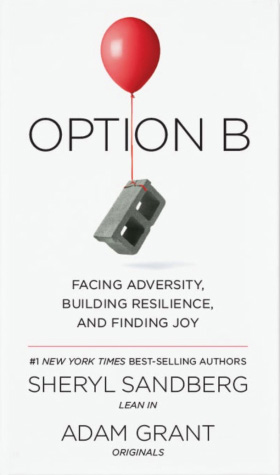
Business leaders can glean several important executivetakeaways from Facebook COO Sheryl Sandberg’s new best-seller, Option B: Facing Adversity, Building Resilience, and Finding Joy. The book bySandberg and co-author Adam Grant focuses on Sandberg’s reaction to the unexpectedloss of her beloved husband, SurveyMonkey CEO Dave Goldberg, who died in 2015at age 47 while the couple was vacationing in Mexico. However, there are several bona fide business lessons to befound within Sandberg’s heart-wrenching tale. These include:
- Building resilience
- The value of failure
- Supporting employees coping withloss
- Interacting with more sensitivity arounda grieving co-worker
Bookbackground
Much of the content in Option B comesdirectly from Sandberg’s journal. It candidly chronicles the young widow’soverwhelming grief in the blurry aftermath of the tragedy; her anguish for herchildren, who were age 7 and 10 at the time; and her thoughts on becoming amember of a club that no one wants to belong to.
Yet the book is not simply a teary personal memoir. It wasco-written with Grant, a noted psychologist, author, and professor at theUniversity of Pennsylvania’s Wharton School of Business. Grant helpscontextualize Sandberg’s personal plight, contributing academic research andpsychological insight about adversity, hardship, and resilience. Interspersedthroughout the work are brave and inspiring tales of individuals around theworld who managed to triumph over a wide variety of tragedies.

Facebook COO Sheryl Sandberg (photo by MattAlbiani)
The book’s title is derived from an incident that occurredshortly after her husband died. Sandberg was lamenting that Goldberg would notbe present at an upcoming father-child activity. Comforting Sandberg, herfriend Phil said, “Option A is not available. So let’s just kick the shit outof Option B.”
Four executive takeaways from Option B
Business leaders can leverage some valuable lessons from Option B. Here are four executive takeaways:
Buildingresilience
Illness and death are inevitable setbacks in life. Yetbusinesses also suffer setbacks. Some, such as 9/11 or the recent financialcrisis, might even be catastrophic. However, in life as well as business,resilience is the characteristic that makes it possible to recover and rebound.The importance of building resilience is a key thread running through Option B.
Sandberg defines resilience as the strength and speed of ourresponse to adversity. “Tragedy does not have to be personal, pervasive, orpermanent,” three Ps she repeatedly refers to in the book, “but resilience canbe,” she writes.
“We all face challenges,” Sandberg notes in a video clipposted on Business Insider. “Some of them are big and huge andtraumatic, and some of them are daily challenges. But we need resilience forall of it.” Grant expands on this concept, remarking, “We can’t control whathappens to us. But we do have some influence over how we respond to the eventsand hardships in our lives.”
According to the authors, resilient organizations share somecommon traits. They place a high premium on personal responsibility, and they activelyencourage employees to confront one another about problems that arise in theworkplace. They value honest and open communication and are willing to engagein conversations that may be difficult.
As a Harvard-trained businesswoman who has also worked at Google,the US Treasury Department, and McKinsey & Company, Sandberg knows hardconversations can be uncomfortable. This is especially true when they concernemployees who are not performing at their peak.
“A single sentence can make people more open to negativefeedback,” Sandberg writes. She advises using positive phrasing such as: “I’m giving you these comments because I have very highexpectations, and I know that you can reach them.”
The valueof failure
The second executive takeaway from Option Bconcerns failure. Successful companies accept, acknowledge, and carefullyscrutinize failure because they regard it as an important learning tool.
“At Facebook we recognize that to encourage people to takerisks, we have to embrace and learn from failure,” Sandberg writes. She creditsthe military for teaching her the importance of creating a culture wherefailure is viewed as a learning opportunity. She shares an anecdote about acompany field trip to a Marine base. She explains how Marines systematicallydebrief after every mission, publicly calling out mistakes made by individuals.At first, Sandberg found this practice harsh and even demoralizing, but she hascome to realize its value.
“When done insensitively, debriefs feel like publicflagellation, but when expected and required, they no longer feel personal,”she writes. She points out that the practice has become common in otherverticals. “In hospitals, where decisions have life and death consequences,healthcare professionals hold morbidity and mortality conferences,” she writes,noting that this often leads to improvements in patient care.
According to the authors, resilient organizations create opencultures that actively encourage individuals to admit, and ultimately own,their missteps. “When it’s safe to talk about mistakes, people are more likelyto report errors and less likely to make them,” they note.
Sandberg acknowledges that getting employees to embracefailure can be challenging. She shares a story about a co-worker at Google whoused to bring a stuffed monkey named Whoops to her team’s weekly meetings.
“She would ask colleagues to share mistakes from that week,and then they’d all vote for the biggest screw-up,” she writes. “The winner gotto keep the stuffed monkey on their desk where everyone could see it until thenext week, when someone else earned the honor.”
Supportingemployees coping with loss
Sandberg started a revolution with her 2013 book, Lean In: Women, Work, and the Will to Lead. The landmarkwork shed a light on the plight of working women and sparked profound shifts inhow modern companies view and value their female employees.
Her new book may have a similar impact on corporate Americain terms of how it supports employees dealing with adversity. Option B is bound to initiate conversations that challenge,and ultimately change, the way companies help employees coping with loss.
“After the death of a loved one, only 60 percent of privatesector workers get paid time off, and usually just a few days,” Sandbergwrites. According to the authors, the corporate standard for paid leave isthree days. Although Facebook actually had a more generous bereavement leavepolicy, Sandberg advocated to extend the policy following Goldberg’s death.Today, the Silicon Valley firm provides up to 20 paid bereavement days—twicewhat was previously offered.
The authors believe that increasing corporate bereavementsupport is not just a moral or compassionate imperative. There are bottom-linebenefits to the practice. According to Grant’s statistics, grief-related lossesin productivity in the United States alone may cost companies as much as $75billion annually. The authors urge employers to re-evaluate their policiessurrounding time off, flexible and reduced hours, and financial assistance foremployees who are grieving.
“We need stronger social insurance policies and morefamily-friendly business practices to prevent tragedy from leading to morehardship,” Sandberg writes. She points out that compassionate firms willbenefit by increasing loyalty among employees.
Interactingwith more sensitivity around a grieving co-worker
While Sandberg advocates that companies offer longerbereavement policies, she notes that getting back to work is often beneficialfor those who have suffered great losses. She recommends that co-workerstreat them with care.
“Don’t automatically assume that the grieving individualwants to be coddled or relieved of their responsibilities. In doing so, you maycontribute to them feeling totally useless, or may be denying them amuch-needed process,” Sandberg writes. That said, she notes that a bereavedcoworker may appreciate the support of colleagues who pick up the slack on anassignment, or demonstrate patience in the face of distracted or erraticbehavior.
Tragedy often creates a paralyzing sense of awkwardness inthe workplace. Although grief-stricken individuals require a lot of support andunderstanding, co-workers tend to either avoid them or politely ignore theelephant in the room. This can isolate the grieving employee, making them feel uncomfortableand increasing their suffering.
“As hard as it was to bring up Dave with friends, it seemedeven more inappropriate at work. So I did not. And they did not. Most of myinteractions felt cold, distant, stilted,” Sandberg recalls. Her boss, FacebookCEO Mark Zuckerberg, explained that co-workers did not know what to say to her.
Sandberg provides some suggestions. Instead of mundanelyasking a work colleague who is dealing with emotional pain the banal question“How are you doing?,” Sandberg suggests saying instead, “How are you doing today?” This subtle change acknowledges the fact that theymay be making incremental progress in their recovery. Additionally, it opensthe door to a potential conversation if the grieving colleague wants to reach out.
Sandberg also encourages grieving employees to be honestabout how they are feeling. “If someone asks, ‘How are you doing?,’ you don’thave to say ‘just fine’ if that’s not true,” Sandberg says. “Tell themyou’re doing about as well as can be expected, or that you’re having a roughday.”
In conclusion
Despite its somewhat depressing subject matter, Option B is actually an optimistic book. It is a quickread, with interesting insights into how individuals and companies can copemore effectively with the inevitable pitfalls of life. There are valuablelessons that apply to everyone.
“In some way, we’re all living Option B,” Sandbergsays. “The idea is how do we make the very most of it.”