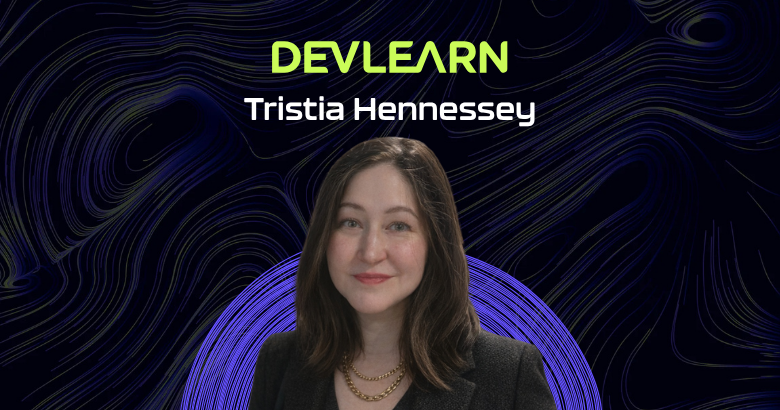
Tristia Hennessey’s path into learning and development began with risk management training for banks, continued through onboarding and administrative work, and eventually led her to enterprise L&D strategy and program delivery. Today, as Senior Instructional Technology Strategist at Evolve Solutions Group, she helps organizations address challenges that extend far beyond a single course or training objective. From software implementation and AI readiness to the everyday friction that can prevent people from doing their jobs effectively.
Tristia understands the power of storytelling, gamification, and realistic scenarios to create learning experiences that are more engaging, memorable, and meaningful and will be sharing her expertise at DevLearn 2026. In this interview, she discusses why storytelling is often treated as a luxury, how small branching scenarios can drive behavior change, and how AI can support the design process without replacing human creativity, context, or judgment.
Q: How did you get your start in learning and development?
A: It was a little bit of a windy road for me. I worked for a training development company that worked exclusively in risk management for banks. Then I moved into some administrative work where I did some onboarding training and I thought, “hey, this is pretty cool.” I really liked that part of my job there, so I pursued a grad certificate at Portland State around 10 years ago, and that was, that was my start.
Q: What does your role look like today?
A: Today I lead L&D strategy and program delivery on multi $1,000,000 enterprise engagements. So, anything from needs analysis through pilot and delivery for F500 clients and utilities, hospitality and and more. We work with all types of businesses, a lot of software training definitely, and tech implementation, AI readiness and anything and everything.
Q: What is your favorite part of the work you do?
A: For me, I like figuring out where the problems are, and sometimes it’s not all training. So when we’re working with SMEs, we often uncover things that cause friction in people’s jobs. And I love finding those little issues and being part of the resolution of something much larger than just like one training goal or one course.
Q: What’s the best learning experience you’ve ever designed and what made it memorable?
A: So for me, it’s a tie between my 2 Demo Fest winning projects, or rather for the first one, the inspiration project for the first Demo Fest win. That project was Sandwich Builder, which we built for a national sandwich chain and that led to Taco Builder and LED to Burger Builder, all for the same family suite of brands. And those won a few different awards as well. My second project that the first is tied with is my more recent DemoFest project that’s a kind of comic book inspired, story based soft skills training kind of gamification elements that were layered into other training course modules for energy distribution controllers.
Q: Why would you say so many learning experiences miss the storytelling development?
A: So I think a lot of it has to do with that people are constantly being expected to do more with less and and hyper efficiency sometimes gets us to focus on like just like how do we outline, how do we bullet point rather than how do we show and demonstrate. And I think, you know, teams end up defaulting to covering content and instead of like, creating situations where there are stakes involved, right? Where there’s a little bit of an element of risk, I guess, safe risk. But when you’re just constantly racing to meet deadlines, I think that things like story and scenarios feel like a little bit of a luxury rather than a necessity. It’s easier to just tell someone rather than to show someone, right? That takes a little bit more of a strategic approach to think about what makes a story good and what makes it a learning moment or a vehicle learning and definitely takes more effort to design that than just to tell someone the facts. So, there’s more effort involved, but I think the reward is greater, and I think especially when the stakes are high, it’s not only more effective, but it is a more engaging and more memorable learning experience.
Q: What’s the biggest misconception people have about creating branching scenarios?
A: I think a lot of what my session talks about is how there’s this misconception that branching scenarios have to be these huge complex stories with multiple endings and all different ways to fail. And not only is it not always realistic, like our work stories aren’t always that deep and complex, but also, it’s just not normally necessary in, in my experience that you can use like small, well-placed branches or scenario bites kind of to demonstrate real world consequences. I find that that can drive behavior change and just better performance without months and months of building time. Planning all these different nodes of a branching scenario. And especially with some of the AI tools and integrations that we have today, you know, there’s a lot you can do to save yourself time on building out branching scenarios. And the tools are getting better and better every day. So, I’ll share some new updates. I’ve given this presentation before, but it’s going to be a little different this time. Every time I give it, it’s going to be a little different because things are just happening so fast right now.
Q: What is something you hope attendees will take away from your session at Dev Learn?
A: I’m going to talk a lot about how to simplify your scenario design, but you know how to get stories. I think we’ll, we’ll look at how to get stories out of your SMEs, how to get started with the design process. We’ll look at some examples and take a peek at some of the AI tools that I’ve been experimenting with that can help you along the way.
Q: With AI making content creation faster than ever, where does human creativity matter most?
A: I would say the story and the judgement calls, you know your organization, you know your work better than AI is ever going to, well, maybe not ever, but it than it does for now. And so, you know, it can help accelerate your production, but it’s never going to replace your judgement. And I, I think especially with knowing whether the story resonates with a human being, sometimes AI can pat itself on the back a little too hard. And I, I don’t find, I, I think especially with like writing fiction or even if it’s like work fiction, you know, like, like not, you know, not like fantasy fiction, AI can still produce some really weird stuff and, and it, it can be pretty rough. So, I think ultimately, it is human creativity that matters. It is the human creativity that matters with AI. I think we need to be able to look at the output and say, “Okay, this is what makes sense in my environment. This is what makes sense for my flow of work.” The story is resolving in a way that makes sense or, you know, it’s moving in a direction that, you know, is showing why these different outcomes are valuable. I think it doesn’t always get the why. And that’s where, that’s where we really need like that human oversight and, and judgement call.
Q: What’s one skill every learning professional should develop over the next year?
A: I want to say just experimenting with different AI tools. There’s so much out there and the advancements are just at breakneck speed right now. I’ve been doing some experimenting with cloud design, cloud Co work. ChatGPT just launched their work app and and they really are kind of game changers for interaction design. If you haven’t dabbled, I I highly suggest you set some time aside to do that.