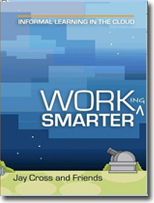
One of the things I like best about Twitter is the collegial,friendly fire-ish banter among L & D professionals. One of themost active of these professionals is the prolific Jay Cross. Jay,with his colleagues in the Internet Time Alliance, has recentlyproduced the 2010 version of his “unbook,” Working Smarter:Informal Learning in the Cloud.
 Convention and controversy
Among the topics often up for grabs lately are ideas aroundinformal learning and the networked learning landscape of the 21stcentury. Those in the quantitative data/metrics/benchmarking campargue against the legitimacy of the notion of “informal”learning. As often as not, they claim workplace learning is tooimportant to be left up to happenstance, and requires planning andcareful, thorough, design. Cross is clear, though, that he is drawingthe “kill the courses, shut down the training department” linewith a dramatically heavy hand, admitting that he uses it as much forshock value as anything else, while trying to put forth the idea ofworkplace learning as different from the traditional view of trainingcourse. He also asserts that “informal” does not, as it so oftenseems to be interpreted, mean “haphazard” or “random.”.
Cross acknowledges the time and place of traditional trainingapproaches, particularly for novices (although he questions thedecision to put so many resources there rather than with supportingbetter producers). But seasoned workers, he rightly notes, will notflock to workshops and traditional classes, as they have work to do.Making it easier for them to get to information, to find one another,to learn through collaboration and by accessing meaningfulself-service performance support, will strengthen the organizationand “help sharp people become sharper.”
From the abstract to the specific
As I said on Twitter one night, “I am 93.2% suspicious ofstatistics about concepts of abstractions like ‘learning’.”While the data we have all seen – along the lines of “80% ofworkplace learning occurs outside the classroom” – may beappealing, and so quotable, we know we can’t actually measureanything like “learning” in these terms. But we do knowthat people learn at work all the time, every day, more from oneanother (even if that “other” is a person who has uploaded avideo tutorial, or updated a Wikipedia page) than from anything thathappens in a classroom. We know that peer groups and communitiesexist to share knowledge and support performance, even if they’rebootlegged and kept under management’s radar. We’ve allexperienced a need-to-know moment, made better or worse by howquickly we could put our hands on the right information or find theright person to ask. Doubt me? For the rest of the week, as you goabout enacting your work, ask how much of what you are doing camefrom anything resembling a traditional classroom or e-Learningcourse.
Cross leads the reader on a tour of informal, networked learningand performance support, and helps move the conversation from 50,000feet to 50. This “unbook” is a compilation of his own ideas aswell as interjections from his colleagues in the Internet TimeAlliance (Harold Jarche, Jane Hart, Charles Jennings, Clark Quinn,and Jon Husband), with chime-ins from many others. There arechecklists, tools, and images, charts and provocative questions. Andthere are honest remarks about the state of learners, many of whomneed to stop waiting for directions and start becoming self-directed.
For me, the most value in the text comes not from the parsing outof the finer points of informal and formal approaches, but thearticulation of the difference between training and learning.Food for thought, from Cross: “If you were to create theorganization’s learning and development function from scratch, whatwould it look like? Are you still doing huge, expensivetraining-based software rollouts, or shifting the effort intoon-point performance support? Have you taken charge of yourorganization’s learning function, or just training?”
The unbook
A word about the book itself – it claims it is not one. It’san unbook, updated every year or so, and published by “Jay Crossand friends,” his colleagues in the Internet Time Alliance Group.Updates appear on Jay’s Internet Time bloghttps://www.internettime.comso, if they strike your fancy, purchase a bound or e-copy update fromJay’s site, from Lulu, or from Amazon. Where traditional booksexist as editions updated every few years, often out of date beforethey even make it to bookshelves, this unbook is always in Beta. Beaware: While Working Smarter is organized into chapters, it isnot the formal, tightly edited, unified work that some readers willexpect from a traditional book. I found the organization refreshing,and the get-to-the-point-already style very effective.
You can also find Jay on Twitter @jaycross, where he’s afrequent participant in the weekly Thursday night #lrnchat sessionsthat I help moderate. Join us! 8:30 to 10 PM ET.
Jay Cross and Friends. (2010) Working Smarter: InformalLearning in the Cloud. Internet Time Alliance: LULU. $20 paper;$16 e-version, available from Luluhttps://www.lulu.com/content/paperback-book/working-smarter-|-january-2010/8259651,from Internet Time https://internettime.pbworks.com/FrontPageand from Amazon.com