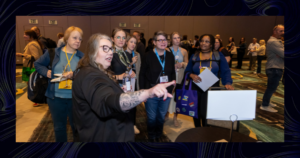
The eLearning Guild’s inaugural Realities360 Conference tookplace in San Jose, California, July 26 – 28. Nearly 250 eLearning professionalsattended this limited-seating event. The theme was “Immerse Yourself inLearning.” Wow, did I ever get immersed! With plenty of opportunities forlearning professionals to dive into new concepts, skills, and virtualexperiences to prepare for the future of learning, I came away energized andready for the challenges to come. Session speakers, keynote speakers, andpanelists, all pioneers in the creation and delivery of these new technologies,brought their knowledge and tools to share with the eLearning community.
Some attendees noted parallelsbetween this conference and The eLearning Guild’s first mobile learningconference, mLearnCon 2010. Back then, training and development professionals questionedwhether mobile devices really had a role in eLearning, and if so, how they shouldplan and prepare for the future of mobile eLearning. In 2017, mobile devicesare everywhere, but now the professionals have similar concerns about thepossibilities posed by the emerging technologies surrounding virtual reality(VR), augmented reality (AR), and enhanced realities (ER).
As it was seven years ago, when thequestions were about the availability and suitability of mobile devices aslearning delivery tools, today there are issues about the headsets,controllers, and other hardware required for delivering the new content. Althoughthere are some inexpensive VR solutions, such as Google Cardboard, the hardwarefor delivering a truly immersive interactive experience is presently cumbersomeand expensive. Further, the tools for creating VR and AR content are often too complexfor content creators to quickly learn. Optimistically, we hope that somethinglike Moore’s Law applies to these technologies, leading us rapidly to a future with untetheredvirtual experiences for learning. Will the L&D community be ready?
We all aspire to create and deliver the best learningexperiences with the most appropriate tools. Knowing what innovators areworking on helps managers plan for certain possibilities, while it encouragescontent creators and learning developers to prepare their own skill sets forthe future. To that end, 2017 Realities360 included a wealth of immersive opportunitiesin just three days.
There’s an app for it!
The Realities360 mobile app by Float allowed attendees tocreate their own personal schedules, access the conference agenda, view venuemaps, and leave feedback on sessions. (No more paper evals!) Perhaps the mostexciting feature of this app was in the AR experiences available by simplywatching for AR markers posted throughout the event and then viewing themthrough the app.
Every attendee received a Google Cardboard headset for usewith their phones, and many put them to use with the Google Cardboard app andvarious demos as examples of affordable VR experiences. Those who loaded theCardboard Camera app created their own VR experiences.
General sessions
There were four general sessions over the three days. Industry experts gave thekeynote speeches both in the opening general session on Wednesday and in Thursdaymorning’s general session, while the last two were a departure from the keynoteformat. During the opening general session, “How VR Is Changing the Future ofContent,” keynote speakerMaxwell Planck described his own journey from Pixar, where they createdstunning animated films, to his move into virtual reality with Oculus StoryStudio, then to the present and the future.
He presented his views on how VR is changingthe future of content and on the greatest challenge to VR, the adoption curve, whichI will discuss in a later article.
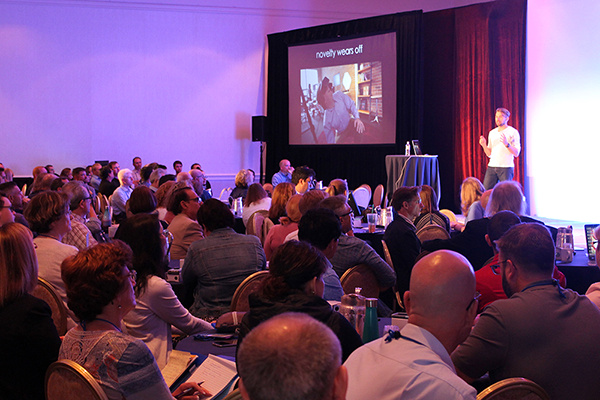
Figure 1:Maxwell Planck, technical founder of Oculus Story Studio, speaking to a raptaudience during Wednesday morning’s opening general session
“What Does the Future Hold for AR, VR, and Mixed Realities?”That was the title of Thursday morning’s general session by Barry Downes,managing partner of Suir Valley Ventures. To guide us toward an answer, heshared how AR and VR technologies are evolving and emerging and where hepredicts their short- and long-term evolution will take us. He showed clipsfrom Apollo 11 VR, a documentary ofthe historic 1969 journey by American astronauts. This is available as an interactiveexperience using the HTC Vive or Oculus Rift. He showed one of the many reviewsof this experience on YouTube in which the reviewer was so awed that he brokedown in tears, an example of VR as an emotional experience.
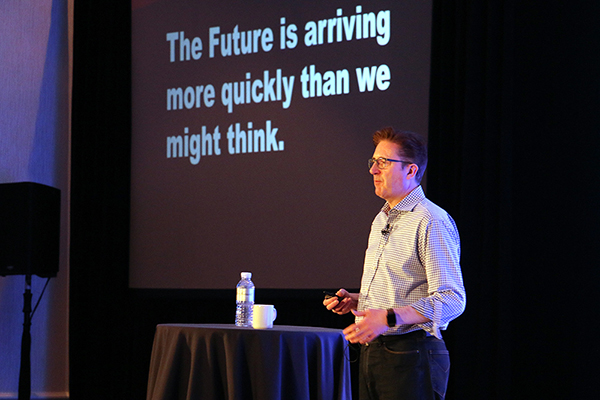
Figure 2: Barry Downes, managing partner of Suir Valley Ventures, the keynote speaker for Thursday morning’s general session
In Thursday afternoon’s general session, “Building theFuture Together,” David Kelly, The eLearning Guild’s executive vice presidentand executive director, led a collaborative discussion with the participants exploringhow the worlds of AR, VR, and other enhanced realities can integrate with learningand development, defining both the opportunities and the barriers to harnessingthe potential of these technologies. Looking forward, they examined what outcomesthe learning community needs from these technologies and what they require inresources to make it happen.

Figure 3: Participantsdiscussed and offered their viewpoints during Thursday afternoon’s generalsession
During Friday’s closing general session, “Lessons Learnedfrom Early AR and VR Adopters,” a panel of four early adopters of AR, VR, andenhanced reality technologies shared their experiences, including bothsuccesses and failures. The panelists were: Chad Udell, managing partner ofstrategy and new product development at Float; Kate Pasterfield, head ofinnovation at Sponge UK; Marco Faccini, chief commercial officer and CLO atImmerse Learning; and Clyde Matava, director of anesthesia innovation,informatics, and technology at Toronto’s Hospital for Sick Children.
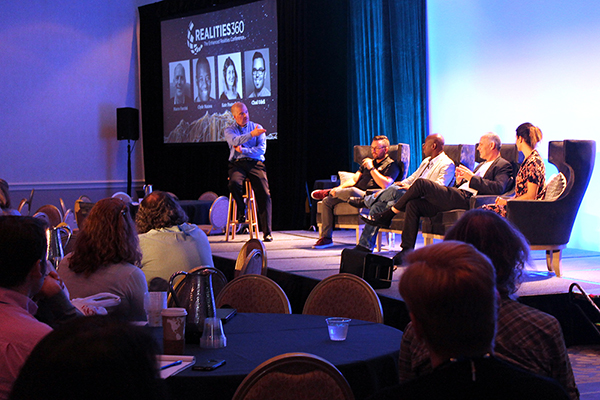
Figure4: A panel of early adopters of AR, VR, and enhanced realitytechnologies
Morning Buzz and concurrent sessions
Early birds brought their coffee to the 13 Morning Buzzsessions, spread over the three mornings of the conference. Each was hosted byone of the session speakers; there was a lot of sharing of experiences andlessons-learned in these casual 45-minute meetings.
The conference organized the 45 concurrent sessions byfocus: augmented reality (AR), enhanced realities (ER), and virtual reality(VR). Several sessions folded two or three of these into their presentations,and some sessions included live demos of finished products. Forty-eightspeakers participated in the concurrent sessions, sometimes in teams, while a fewspeakers presented more than one session.
Six concurrent Bring Your Own Laptop® (BYOL) sessionsoffered hands-on experience using tools for getting started with AR and VRwithout breaking the budget. I looked in on several of these to see peopleengaged in creating and testing. When I looked in on Friday morning’s “BYOL: Low-Cost,High-Impact AR Experiences,” everyone was at the front of the room using theirphones to scan special images to use in the AR experiences they were about tocreate. The other sessions were just as compelling. When attendees were intheir seats, they were leaning forward to catch every ounce of knowledgefloating through the air.
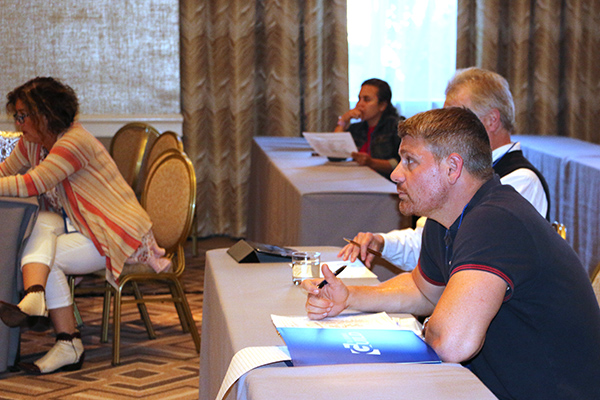
Figure 5: Attendees leaning in to get the most out of one of the 45concurrent sessions
While I expect Realities360 to be an annual event, for thoseof us needing to check in with the experts in AR and VR, The eLearning Guild’s DevLearn 2017 Conference & Expo in Las Vegas this October features an EmergingTechnologies track. Look for new speakers there, as well as some familiar facesfrom Realities360 including Destery Hildenbrand, Sherry Larson, and CindyPlunkett.
Immersion in the Technology Showcase
Leading companies creating AR and VR L&D solutionsoffered hands-on time with their latest products in the Technology Showcase.Their stations were set up in the ballroom and open for a total of more than 16 hours over Wednesday andThursday. Participants moved among several stations, where they could shed thereal world and immerse themselves in a variety of virtual experiences using thelatest hardware, often head-mounted displays (HMDs) and controllers forinteraction in virtual scenarios. The eight Technology Showcase sponsors offeringthese experiences were Float, Indusgeeks, Interactive Learning Experience,Lionbridge, Mutual Mobile, nawmal, TalentQuest, and VirBELA.
At the Indusgeeks station, I went through the Disaster Emergency Response Triagetraining simulation of an earthquake, attempting to do triage on an injured manwhile the earth rumbled, sirens wailed, buildings crumbled, and an EMT avatarguided me through the necessary steps (bringing my kit to the gurney, assessingthe patient, and attaching the AED). Somehow, I managed to resuscitate him. Themost important takeaway was that I became emotionally involved with a realadrenaline rush. I now appreciate all the distractions faced by EMTs inreal-life situations. I was not so successful at another station where I alloweda virtual fire to get out of hand in a virtual warehouse. I could have used alittle more adrenaline there.
The eLearning Guild provided three additional stations inthe Technology Showcase. The Oculus Rift station offered the VR films Henry and Dear Angelica, as well as gaming applications Robo Recall and The Climb.Those who visited the PlayStation VR–equipped station could pilot an X-wingfighter in Star Wars Battlefront,work physics-based puzzles using TumbleVR, or spend time on a hostile alien planet using Farpoint. The third eLearning Guild station used the HTC Vivesystem with several great interactive experiences, including Slingshot, Longbow, and Human MedicalScan. One participant remarked on Twitter that she tested her fear ofheights using the HTC Vive. She saidthat her heart was racing and her head was spinning, and she was scared—a greatexample of how VR makes it real.
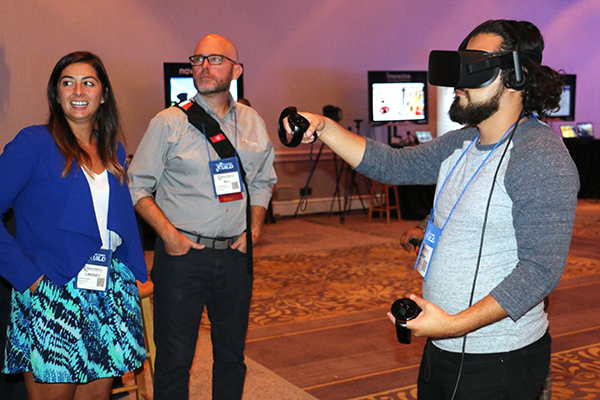
Figure 6: Attendees tried out immersive experiences in theTechnology Showcase
Stepping onto the invisible bridge
Those eLearning professionals who pursue new ways to aidlearning are stepping off the cliff at the end of the firm ground of theireLearning experience and hoping there is a hidden bridge underfoot. AtRealities360, the keynote speakers, session presenters, and participatingvendors effectively revealed the hidden bridge. Now it is up to individuals andorganizations to take those important first steps.
Conclusion
We learn best through experiences, and VR and AR can putlearners into the middle of scenarios where they experience visual and auditorystimulation and even perform tasks. Using VR and AR, a learner can practice atask repeatedly without using expensive materials or needing to fix damage done(recall the warehouse fire). The classic virtual learning experiences, flightsimulators, have been around for many years, but even these are improved by newtechnologies. However, before a wide range of educators will embrace the hugepotential of VR and AR for learning, they will need easier tools for creatingthe content, and the hardware for delivering it must be less bulky and more affordable.