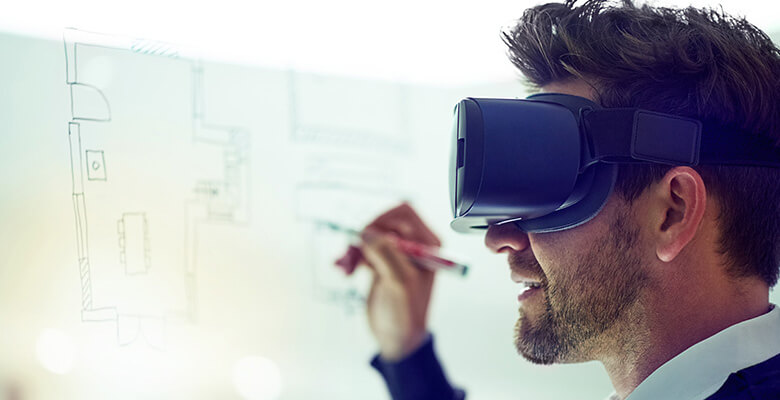
Virtual reality (VR) is quickly entering theworld of training, as VR has shown tremendous potential to revolutionize theway companies provide employees with the knowledge and skills to succeed (andstay safe). Based on previous research (for a more detailed analysis of theprevious research you can read the full report here) there are a few proven ways in which VR canimprove employees’ ability to learn. At the highest level, these improvements includethat VR is more memorable than video content, is a safe alternative to realworld training, is easily repeatable and scalable, and provides isolation fromdistractions. With an understanding of where VR is best suited to help peoplelearn, VR training development requires only a few actionable steps thatcompanies can take to capitalize on this opportunity for innovation andimproved learning.
Step1: Examine your curriculum
Companies should first take a step back toevaluate their entire training curriculum. This may seem tedious, but othershave found this step to be one of the most valuable. According to Keith Daly of Farmers Group, taking the opportunity to “discover gaps inyour curriculum that you might not have otherwise found … can give you theopportunity to improve your training, adding value to the employee experienceand strengthening customer service.”
Step2: Identify opportunities for testing
After examining their curriculum, companiesshould identify the portions that could potentially benefit from VR based onwhat previous research shows are the advantages of using VR.
Increasedretention of training content
As shown in research by Benjamin Schöne, subjects who trained with VR video performedtwice as well on memory retrieval tests in the subsequent 48 hours as did subjectswho trained with 2-D video. Given this research, VR should be explored as aviable option for any training that involves memorization, especially ofspatial or visual information.
Isolationfrom distraction
Are there any portions of the trainingcurriculum that are critical but not necessarily engaging? For example, firesafety training is something most employees (or students) will generallyignore, or pay very little attention to, even though engagement with thistraining has the potential to save lives. Oftentimes in evacuations, everyonegoes to the most visible or familiar emergency exit path, ignoring other exitroutes because they did not pay attention to fire safety training material.Transferring training procedures that rely on focused engagement and freedomfrom distractions, such as fire safety training, to a VR platform can be both apractical and an ethical choice.
Repeatableand controlled exposure to stressful situations
This attribute of VR is applicable to manydifferent types of training. It has already been proven effective in trainingpeople to get more comfortable with public speaking by letting the userpractice in front of varying crowd sizes. This feature of VR training can also beused in any way that requires the employee to become habituated to potentiallystressful situations. For example, VR could be used to improve CEO performancewhen giving keynote presentations by reducing the stress response to publicspeaking through repetition. Customer representatives could practice beingconfronted by angry customers, while learning to remain calm.
There are a number of ways in which VR could beapplied to make use of this important attribute, providing the ability topractice and train in a way that was previously only possible through repeatedexperience or specialized and expensive in-person training.
Safety
All companies should explore any and allpotential technologies that could help increase the safety of their employees.If a company engages in any activities that expose its employees to healthrisks, it is worth immediately conducting tests to determine if VR can helpreduce those risks.
A simple, yet useful training application forany company that operates factories might be one that familiarizes employeeswith the facility floor. The company could add onto this training by havingemployees identify potential health hazards or by training them on the properemergency and evacuation procedures even before they set foot in the facility.
Step3: Start testing with linear and interactive 360 video
Some VR use cases will achieve outstandingresults, whereas others may not have the same outcomes, given the currentlimitations and attributes of the technology. And, while previous research maypoint us in the right direction, only testing and iterating the various uses ofVR will lead us to the best results.
Given the state of VR and available tools, theuse of 360-degree videos may be the best way to start using VR technology fortraining. Research from Benjamin Schöne concluded that “For HMDs to become arelevant tool for instructors, [the instructors] must have the ability toproduce and edit their own content. This is starting to happen with contentbased on 360-degree video footage, and currently the most promising use of HMDsin education may not be educational VR simulations, but the HMD as a viewer of360-degree video content, which can form the basis of subsequent educationalactivities such as classroom discussions, written analysis, group work, orassessments.” These production and editing tools exist today and the creationof 360 video experiences is becoming increasingly accessible
Also, 360-degree video is much morecost-effective and scalable than going full out to create computer graphics orlive-rendered content for the Oculus Rift and HTC Vive headsets. It alsoperforms well on mobile VR platforms such as GearVR and the Oculus GO. Inaddition, 360-degree video today is simply more realistic. Knowing the importanceof simulation fidelity, there’s good reason to believe that it will lead tobetter training outcomes.
Additionally, previous research has found that alimiting factor in the effectiveness of VR training is that people can beeasily overwhelmed by fully interactive (six degrees of freedom) and room-scaleVR experiences. In contrast, 360 video and interactive 360 provide much moreaccessible experiences, while still giving users the opportunity for simpleinteractions.
Using 360-degree video, the tools and softwareavailable today should make it easy to get started on testing different usecases.
Step4: Measure results
Since results will likely vary depending on eachspecific use case, measuring effectiveness is critical. Determining which resultsto measure and how to measure them will therefore be important parts of theplanning process. The most straightforward solution is to work with a partneror software that provides in-depth analytics on any of the training contentbeing tested.
Overall, it is not so much a question of whetherto use VR for training, as it is a question of when and how.Without doubt, most companies of any significant size will have opportunitiesto use VR training development to improve their employee’s ability to remember,train more frequently, and stay safe and engaged.
Editor’sNote
Want to learn more about virtualreality, and more from the author? Alejandro Dinsmore will be presenting thesession The Neuroscience of VR Training, and Why It Works at The eLearningGuild’s Realities360 Conference. The conference is June 26 – 28 in San Jose,California, and features dozens of sessions exploring the use of augmentedreality, virtual reality, and simulations in eLearning, as well as keynotes by Jaron Lanier and Rika Nakazawa.
For additional perspective from Learning Solutions and The eLearningGuild on virtual reality, you may want to review these resources:
“AR,VR, and Enhanced Realities: Seven Perspectives on the Potential and Risks forLearning”
“LostAmong the Realities: A Guide to Virtual, Augmented, and Mixed Reality”
“FourEssentials for Effective Learning Using Virtual Reality”