




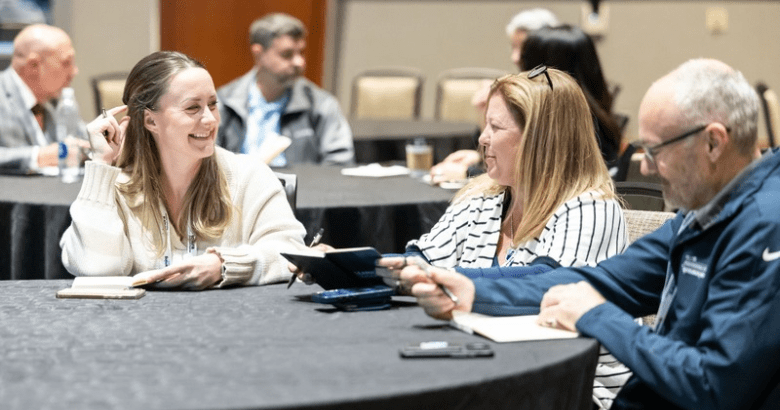
Learning Leadership is designed for candid conversations about the challenges shaping learning, talent, and organizational performance.
Leaders come together to share experiences, compare approaches, and explore practical ways to support their people and organizations through change. At Learning Leadership 2026, attendees were asked to reflect on one idea they planned to take back to their organizations. Their responses revealed four priorities: strengthening leadership capabilities, creating psychological safety, scaling AI, and demonstrating the broader value of learning.
Leadership skills should extend beyond the leader
One attendee was thinking about how to extend leadership and coaching skills beyond the people who hold formal leadership roles.
The idea was to equip everyone across the organization with the same strategies that help leaders communicate, coach, and support their teams effectively. When direct reports understand those skills and how to apply them in their own work, leadership development becomes more than an individual capability. It becomes a shared approach that can strengthen collaboration and performance across the organization.
Build psychological safety into how teams work
Another attendee left the event focused on the importance of addressing psychological safety, particularly during a period of significant volatility and uncertainty.
Creating an environment where people feel comfortable asking questions, sharing concerns, challenging assumptions, and trying new approaches is essential for organizations navigating change. Psychological safety helps build trust within teams and gives people the confidence to contribute, adapt, and learn from one another.
For learning leaders, that means supporting not only the development of new skills but also the conditions that allow people to use those skills effectively.
Scale AI by empowering people
AI adoption was another major focus for attendees considering how to move from experimentation to broader organizational use.
One leader was exploring how to scale AI across the organization while helping employees feel more empowered to use it. That includes creating opportunities for people to share their experiences, recognize successful applications, and learn from one another. Developing clear personas for how different groups will use AI can also help organizations create a more intentional and inclusive approach to adoption.
The takeaway is that scaling AI is not only a technology challenge. It is also a people, culture, and learning challenge.
Use analytics to tell a fuller story about learning
For another attendee, the most important takeaway centered on analytics and the need to communicate the value of learning beyond a single return-on-investment calculation.
Learning leaders are increasingly expected to connect their work to organizational priorities and demonstrate measurable impact. At the same time, the value of learning can extend beyond direct financial outcomes to include stronger capabilities, improved confidence, better performance, and greater organizational readiness.
Using analytics to tell that broader story can help learning leaders communicate the full contribution of their work and make more informed decisions about where to focus their efforts.
Turning shared insight into action
At Learning Leadership, leaders have the opportunity to step away from day-to-day demands, speak candidly with peers facing similar challenges, and return to work with new perspectives and practical strategies. Sometimes the most valuable takeaway is a specific tool or approach. Other times, it is a better question, a new way of framing a challenge, or the confidence to move forward with an idea.
Learning Leadership 2027 returns October 4–5 in Las Vegas at Caesars Forum. Make your plans to join the conversation and register for Learning Leadership 2027.


