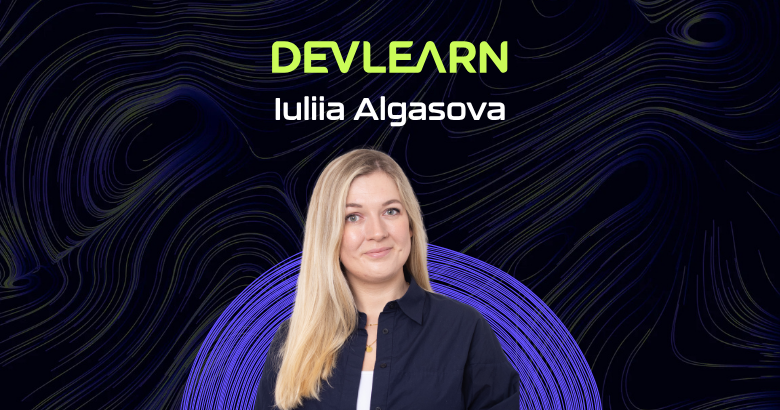
Iuliia Algasova is a learning leader focused on skills development, capability building, and the thoughtful use of AI in learning. As Vice President, Skills Development at BlackRock, she works at the intersection of business needs, workforce capabilities, and modern learning design, helping develop job-ready skills at scale. Her background in teaching, online learning, and content strategy brings both innovation and empathy to her work, while her recognition as one of the Learning Guild’s Thirty Under 30 reflects her commitment to practical, human-centered learning.
In this Q&A interview, she discusses how skills can create a shared language across learning, talent, and the business; why organizational commitment is essential to becoming skills-based; and the practical first steps she’ll help attendees explore at DevLearn 2026.
Q: How did you get your start in learning and development?
A: I started way 10 or 12 years ago as a teacher, actually. I was a teacher of English and literature in a school, then I moved on to work for an IT Corporation as the teacher of English there. And very quickly, I realized that we really don’t have a methodology for teaching people to speak English in their work environment. The current textbooks we were using were not good. So that’s how I got into instructional design, got a degree in instructional design, and got so passionate about it, about teaching people, finding the right methodology, really using those adult learning principles just to make this effective. Slowly, I got into it more and more each year. I became a manager of a small group of instructional designers, and then slowly started changing the strategies that we have in learning.
Q: What does your current role look like?
A: Currently, I am the head of skills development efforts at BlackRock. My role is everything that is skill-related. It involves finding out why we need skills to behave as an organization and to perform well, getting people to commit to having those skills, getting people to buy in, especially the senior stakeholders, helping them see how this can be helpful, and then all of the developmental efforts in this regard. So, building skills taxonomies, making sure we have the technology to support them, ensuring data is valid and objective, and that we can truly exchange it between different people and HR systems. This is what I’m focusing on right now.
Q: What is your favorite part of the work you do?
A: My favorite part is the skills related to learning and development. There is a lot of work that is concerning different people and functions, so how do we use skills for internal mobility or how do we use them for performance rewards? So when it comes to learning and development, that’s where my passion lies, because having skills data helps you really transform the learning landscape and make sure that it’s as personalized as it can be, and people are really getting just the things that they need to, so I, as an employee, can really see where my next goal is and match my learning to that.
So, working on that, on matching these learning opportunities, on building these personalized pathways, and then making sure that technology works the right way. That’s the most exciting part of this whole skills initiative.
Q: Was there a project that convinced you that skills were more than just a buzzword?
A: Yes, so in my previous workplace, EPAM Systems, we were a truly skills-based shop. We used skills for everything from learning and development to hiring to picking people for projects. That’s where I could see that it truly works. It works from hiring the right people because you already knew which exact skills you need and you already had the mechanisms to verify if people do have those skills or if they need to work on them a bit and hire as a skills promise. For example, you could see what exact people you would need for the project to be successful and you could find them internally in a huge 65,000 people organization. You could find just the right pick and really make sure that the project is successful. As an employee, I could see that, okay, this is my goal, this is where I want to move, either upskill in my current role, move beyond my role horizontally, vertically, this is where I need to focus, and these are the opportunities that I have. This was really amazing to see. The people were motivated and they could see that learning truly drives their career forward, but also managers and stakeholders could create those teams that are effective and could really see how they can utilize the whole workforce that we had at the company.
Q: Can you give a sneak peek into the session you’ll be leading at DevLearn?
A: So, no surprise, we’ll talk about skills. We’re going to talk a lot about why do organizations need skills? Is that something that every organization can benefit from? And then what are the easy steps to really start off on this journey if you feel like that’s a benefit for you and your organization.
So where do we start? Do we start with the taxonomy? Do we start with an inventory? Or do we start with the technology? And then what are the easy steps we can take? Something that does not require a lot of budget, something that does not require a lot of time commitment, but still something that can drive us forward and just show us, is that working for us correctly or not.
We’ll go over these practical steps and I think we’ll even try building out a blueprint of how we can reuse these learnings in our own organizations.
Q: In your opinion, why do so many organizations struggle to connect to learning talent and business goals through skills?
A: I think, because it’s a very heavy task. I think that having skills for organizations is kind of like establishing a new language everyone speaks. So, if we imagine that, you know, business is one country and then HR function and learning and development culture are different countries, they all speak different languages.
They can’t really exchange ideas or data and sometimes they don’t even want to get to know each other that much. I think that’s where a lot of problems and challenges arise. Skills is like we are all deciding that we now speak one language, one shared data.
It unlocks so many opportunities, but it’s such a commitment just to make sure that everyone agrees to learn this new language and that everyone agrees this is the end source of truth. So I think the skills are hard, not as much because of technology or governance, but also about this commitment. It’s largely about making sure people buy into this idea at first. If they do, that’s already a huge step. Everything else comes in much easier.