



By George Hall
In 2003, I interviewed Noel Tichy about leadership, organizational learning, and what he called the Cycle of Leadership. Reading that interview 23 years later is eye-opening. Part of the surprise is how contemporary it still sounds. Tichy was discussing the need for leaders to connect strategy with values, develop people, work on real problems, accept feedback, and build organizations in which everyone learns, and everyone teaches.
Another part is more troubling. The interview now feels like evidence from a leadership tradition we are beginning to forget. Tichy’s central idea was that leadership is not simply the exercise of authority. Leaders teach. They teach through the ideas they advance, the values they enforce, the decisions they make, the questions they ask, the people they develop, and the behavior they reward.
Many current L&D practitioners may recognize pieces of this philosophy without having read Tichy directly. Leader-as-teacher programs, action learning, real-work projects, cascading leadership development, and teachable points of view remain familiar ideas. But Tichy himself is less visible in the contemporary conversation.
His ideas have been absorbed into the field—so thoroughly—that many practitioners recognize the practices without recognizing their source. That matters because a very different philosophy of leadership is gaining strength—one centered less on learning than dominance, less on integrity than loyalty, and less on developing people than controlling what they are permitted to see and speak.
A Teachable Point of View
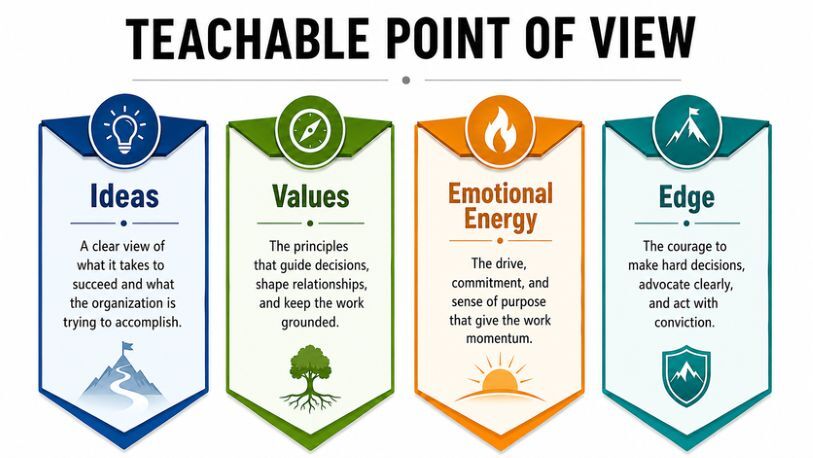
In our interview, Tichy told me that the first challenge of leadership was the difficult intellectual work of developing a Teachable Point of View, or TPOV. A TPOV was not a slogan or an executive presentation. It contained four connected elements:
Ideas
A leader needed a clear view of how the organization would succeed, create value, and accomplish its purpose.
Values
The leader needed principles that would guide decisions, relationships, and the way results were achieved.
Emotional Energy
The leader had to create commitment, purpose, and the momentum needed to move people from understanding to action.
Edge
The leader needed the courage to make difficult decisions, demand accountability, and act on the ideas and values being taught.
Strategy could not be separated from values. Tichy was particularly direct about integrity:
“Operationalizing integrity is critical.”
He did not mean placing integrity in a values statement. He meant building it into relationships, decisions, accountability, and the way an organization dealt with employees, customers, suppliers, and partners.
Twenty-three years later, that idea feels almost radical. Many organizations still communicate values. Fewer are willing to let those values constrain leaders when the values become inconvenient.
That is the real test.
A value is not operational because employees can define it. It becomes operational when it affects who is promoted, what behavior is rewarded, which results are rejected, and whether the same standard applies to people with power.
What the ICE Article Left Unanswered
In “What Training Teaches Us to See,” I argued that training does not merely teach action. It teaches perception. The article examined recent ICE vehicle-stop shootings and asked what the larger institutional system had taught agents to see before force was used:
- Did movement appear as fear—or as aggression?
- Did confusion appear as uncertainty—or as resistance?
- Did a person inside a car remain a frightened human being—or become a threat object?
My central point was that formal training is only one part of the learning system. Mission language, political rhetoric, peer behavior, supervision, rewards, accountability, and these leadership signals all shape how people interpret an ambiguous situation.
But that argument leaves another question: Who really teaches the institution what to see?
The answer, of course, begins with leadership. Leaders do more than communicate priorities. They create the interpretive frame through which other people understand their work. They teach:
- Who deserves concern
- Who counts as a threat
- What results matter most
- Which facts receive attention
- What questions are dangerous
- Whose mistakes will be forgiven
- What happens to people who challenge the dominant account of reality
That is why a leadership crisis cannot be solved simply by providing employees with more training.
The people at the top are already teaching. The question is what they are teaching the institution to become.
The Leader as Learner & Teacher
Tichy’s philosophy was built around the leader-teacher. The leader develops a clear point of view, teaches it, listens to other people, works with them on real problems, and develops their ability to teach and lead others. The process then spreads:
- Leaders create leaders
- Teachers create teachers
- Learning produces more learning
Tichy called this a Virtuous Teaching Cycle. It is both beautiful and elegant. The purpose was not endless conversation or leadership as personal therapy. The approach was demanding. Tichy believed leaders needed Edge: the willingness to make difficult decisions, require accountability, and push senior teams to align around ideas and values. His philosophy was not anti-authority. It was about what that authority was for.
Authority should be used to build capability throughout the institution, not to make the institution permanently dependent on the person at the top.
Tichy rejected the image of the football coach calling every play from the sidelines. He preferred what he described as flow sports, including basketball and hockey, where people must interpret changing conditions and make decisions in real time.
The leader’s role was to develop people who could think, adjust, teach one another, and act without waiting for every instruction.
That distinction is crucial. A strong leader does not create more followers. A strong leader creates more people capable of leadership
The Leadership Philosophy Replacing It
The corrosive philosophy now appearing in some public institutions also understands that leaders teach. It simply teaches different lessons:
- Strength means never admitting uncertainty
- Loyalty matters more than expertise
- Disagreement is treated as opposition
- Institutions exist to carry out the leader’s will
- Public humiliation demonstrates authority
- Facts matter when they support the approved mission
- People who bring unwelcome information become part of the problem
This philosophy may still use the language of leadership, performance, transformation, and accountability:
- It may be energetic
- It may produce rapid action
- It may appear decisive
But it does not create a teaching cycle. It creates what I think of as a dependency cycle:
The leader supplies the approved interpretation of reality. Subordinates learn to anticipate it. People who repeat it are rewarded. People who complicate it lose access, influence, authority, or employment.
The organization may become highly responsive to the leader while becoming progressively less responsive to reality. That is not strong organizational alignment. It is institutional narrowing.
The Vicious Non-Teaching Cycle
In our 2003 interview, Tichy contrasted virtuous teaching cycles with what he called Vicious Non-Teaching Cycles. That idea may be even more important today. A vicious non-teaching cycle can develop in five stages:
1. The Leader Narrows Acceptable Reality
The leader announces not only what the organization will do but also what people are expected to believe about the situation.
The mission becomes morally certain.
Complexity becomes suspicious.
2. Loyalty Replaces Feedback
Employees learn that the safest response is agreement.
They may still possess expertise, but they begin filtering what reaches the top.
Research on employee voice shows that people develop unwritten beliefs about when speaking up is risky, futile, or inappropriate—even when their information could help the organization.
3. The Leader Receives Worse Information
Because disagreement has become costly, the leader encounters less contradiction and fewer warnings.
This may feel like stronger alignment, but it is actually declining informational quality.
4. Errors Grow
The organization acts on an increasingly narrow picture of reality.
Mistakes are blamed on weak execution, insufficient commitment, disloyal people, or external enemies rather than examined as possible failures of leadership judgment.
5. Control Intensifies
The response to failure is more pressure, tighter message control, stronger loyalty tests, and the removal of additional dissenting or independent voices.
That produces even less-accurate information. The cycle feeds itself. The leader becomes more certain as the institution becomes less capable of correcting the leader.
Teaching or Indoctrination?
There is an important complication: A destructive leader may also possess a teachable point of view. This is a sad occurrence. The leader may communicate it constantly. It may cascade through the organization. Employees may repeat its language. Managers at every level may be required to transmit it. That can look superficially similar to Tichy’s model.
The key difference is whether the system remains open to learning. A “genuine” teaching cycle includes:
- Interaction
- Application
- Reflection
- Feedback
- Self-examination
- Adjustment
An indoctrination cycle moves primarily in one direction: The powerful teach; everyone else demonstrates acceptance.
Tichy was explicit about the difference. He criticized leaders who reduced teaching to standing behind a PowerPoint presentation. In his model, leaders entered into dialogue, worked with people on real projects, and became smarter through the interaction. The leader was expected to change, too.
That is the dividing line: In a teaching organization, the leader teaches and learns. In an indoctrinating organization, the leader teaches and is protected from learning.
Why Vulnerability Matters
One of my questions to Tichy concerned vulnerability: Why would a powerful executive need to let people see the leader as a real person?
Tichy answered through an example of his work with PepsiCo CEO Roger Enrico, who brought small groups of executives to his ranch for intensive work on leadership and real growth projects.
Tichy said, “If Roger Enrico showed up with a teleprompter and a bunch of bureaucratic minions, he would get no respect.”
Enrico had to enter the conversation, coach, teach, hear ideas, and expose his own thinking to examination.
Tichy described a similar expectation at GE’s Crotonville leadership center: Leaders did not arrive simply to broadcast. They interacted with managers and came away smarter themselves. That interaction produced credibility. Tichy summarized the philosophy in one sentence: “Great leaders are great learners and great teachers.”
He connected leadership with self-examination, reflection, feedback, role modeling, and helping other people develop. Vulnerability, in this model, was not confession for its own sake. It was the willingness to let contact with reality change you.
The corrosive model treats that openness as weakness. Certainty is performed even when uncertainty is real. Error is displaced. Questions become challenges to authority. The leader’s image must be protected from the learning process. That does not produce invulnerability. It produces brittleness.
Operating Systems Are Learning Systems
Tichy also made a point that L&D should strive to recover. The normal operating systems of an organization are learning environments:
- Strategic planning teaches what kinds of evidence matter
- Succession planning teaches what kind of person advances
- Financial planning teaches what the organization considers valuable
- Performance management teaches which results matter and which methods will be overlooked
- Investigations teach whether accountability is real
- Promotions often teach more powerfully than values statements
Tichy observed that many organizations had allowed these processes to become stale bureaucratic rituals that drained energy. But he believed they could be deliberately designed as rich learning and teaching environments.
This point connects directly to the ICE analysis—an enforcement agency teaches through more than its academy.
It teaches through:
- Mission framing
- Operational targets
- Political language
- Supervision
- Use-of-force review
- Body-camera expectations
- Promotions
- Protection of employees
- Treatment of critics, and, crucially,
- The stories leaders tell about the people they encounter
The same is true in corporations. A company may teach integrity in a course and teach something else through its sales incentives. It may teach psychological safety while promoting the executive who silences disagreement. It may teach respect but protect a high performer who abuses employees.
Psychological safety supports learning because it allows people to take interpersonal risks, admit errors, raise questions, and challenge assumptions. When those actions become unsafe, the organization loses access to the very information it needs in order to learn.
Operating systems do not always defeat formal learning. But when training and the operating system teach opposing lessons, isolated training is usually the weaker teacher.
What L&D Should Recover
Tichy’s work should not be remembered merely as an interesting theory from the GE era. It contains principles L&D urgently needs:
- Leadership is always teaching
- Leaders teach whether they intend to or not. Their behavior becomes a default curriculum.
- Integrity must be operationalized
- Values are not real because they have been communicated. They become real when they shape decisions, rewards, accountability, and relationships.
- Authority should build distributed capability
- The purpose of leadership is not to make everyone dependent on the leader’s interpretation. It is to develop more people who can think, judge, act, and teach.
- Real learning must touch real work
Tichy emphasized action learning because difficult judgment develops through practice, feedback, and consequence—not through content exposure alone.
Leaders Must Remain Inside The Learning System
The person at the top cannot be exempt from feedback, reflection, correction, or growth. Once the leader becomes unteachable, the institution begins losing the ability to teach itself.
The Thinker We Are Forgetting
When I interviewed Tichy in 2003, I understood, then, that he was describing a very powerful approach to leadership development. I do not, however, think I fully understood that he was also describing a vital safeguard.
Virtuous teaching cycles do more than improve performance.
- They distribute intelligence
- They connect values to operations
- They keep leaders in contact with other minds
- They make disagreement useful
- They create people throughout the institution who can recognize problems, exercise judgment, and teach others
A vicious non-teaching cycle reverses or undermines every one of those protections:
- It concentrates interpretation
- It separates values from action
- It makes disagreement dangerous
- It rewards performances of loyalty
- It teaches people to stop bringing reality into the room
Thankfully, Tichy’s influence has not disappeared entirely. Michigan Ross still credits his action-learning ideas with helping shape its leadership programming, and recent ATD materials continue to use his Teachable Point of View framework.
But many current practitioners may know the descendants of his ideas better than the thinker who developed them.
The danger is not simply that fewer people are reading Noel Tichy
The danger is that we are forgetting the philosophy of leadership he represented at the same time a more corrosive philosophy is showing how quickly institutions can be reorganized around power, certainty, fear, and obedience
But forgotten is not the same as lost.
- My interview still exists
- The ideas still exist
- This strong leadership tradition still exists
Twenty-three years later, Tichy’s work does not read like a relic. It reads like a warning—and a recovery plan.
Author’s Note
After completing this essay, I had the opportunity to speak again with Dr. Noel Tichy. Our conversation reinforced a central concern: Organizations continue to become trapped in vicious cycles of non-learning.
In Dr. Tichy’s view, history keeps repeating itself—not simply because leaders lack information, but because organizations are often unwilling to do the real work that learning requires. He was characteristically direct about this. Too many leaders look for an easier way. They want the benefits of organizational learning without accepting its discipline, discomfort, or demands.
Real learning requires action learning: acting, examining what happened, confronting mistakes, and carrying what was learned into the next decision. Dr. Tichy pointed to the Navy SEALs, with whom he has worked closely, as a powerful example. Their after-action reviews are built around straightforward but demanding questions: What happened? What did we learn? What must we do differently next time?
During these reviews, rank is set aside. Reality matters more than hierarchy. Everyone is expected to contribute to the learning, and leadership is mobilized throughout the organization. This reflects a principle that has shaped Dr. Tichy’s work for decades: Organizations must develop leader-teachers at every level—people who do not merely issue instructions, but help others interpret experience, develop judgment, and become leaders themselves.
Reflecting on his years working with Jack Welch, Dr. Tichy recalled that Welch would come to GE’s Crotonville campus every other week to speak directly with participants. Leadership development was not delegated to a training department or treated as a peripheral activity. The chief executive was personally involved in teaching, challenging, listening, and developing the next generation of leaders.
Dr. Tichy also pointed to Robert Knowling and his book, You Can Get There from Here, as a powerful example of leadership grounded in learning, responsibility, resilience, and direct engagement. Knowling’s story illustrates that transformation is not produced by slogans or abstract systems. It occurs through the difficult work of helping people see new possibilities, take responsibility, and act differently.
The commonalities among the leaders and organizations that get this right are striking:
- They create time for reflection
- They make experience discussable
- They reduce the distorting effects of rank
- They expect leaders to teach
- They treat mistakes as material for learning rather than merely as occasions for blame
- Most importantly, they do not confuse activity with learning
We agreed that the tragedy is that none of these lessons is new. We already know what serious organizational learning requires. History continues to repeat itself because too many institutions want the appearance and benefits of learning without undertaking the work that makes learning possible.
References
- Detert, J. R., & Edmondson, A. C. (2011). Implicit voice theories: Taken-for-granted rules of self-censorship at work. Academy of Management Journal, 54(3), 461–488.
- Edmondson, A. C. (1999). Psychological safety and learning behavior in work teams. Administrative Science Quarterly, 44(2), 350–383.
- Hall, G. (2003). How great leaders teach their companies to win: An interview with Noel Tichy. T+D. American Society for Training & Development.
- Hall, G. (2026). What Training Teaches Us to See: High-Stakes Learning Systems Shape Perception Before They Shape Action. The Learning Guild.
- Tichy, N. M. (1998). The teaching organization. Training & Development.
- Tichy, N. M., & Cardwell, N. (2002). The cycle of leadership: How great leaders teach their companies to win. HarperBusiness.
Image credit: z_wei

