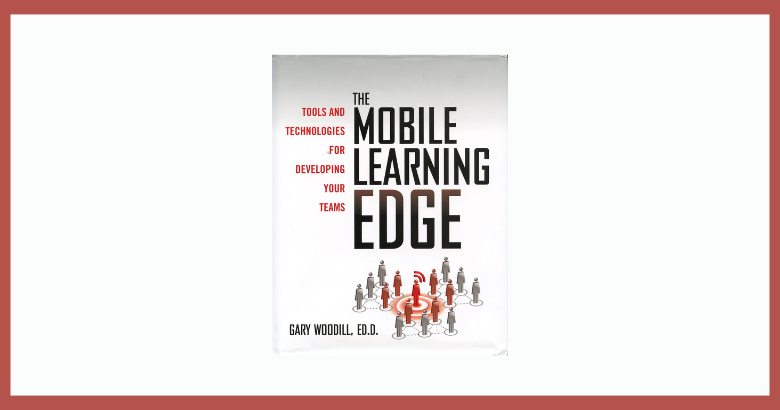
GaryWoodill, senior analyst at Brandon Hall Research, has contributed anew book to the slowly growing library on mobile learning.
The Mobile LearningEdge seems intended for training managers and educators in the mainstreammarket, and for others who are new to or only just becoming aware ofthe potential of mobile technologies for learning. If you knowsomeone who is trying to come to grips with the evolution of yetanother disruptive technology and the associated disintermediation,this book may help them. Early adopters and others who are alreadymaking use of mobile devices to facilitate learning and to supportperformance will not gain much from it, other than a source ofexplanations that will help others get up to speed.

What’s in the book
Thebook’s sub-title is “Toolsand technologies for developing your teams.”In support of this, Woodill and two contributors offer ten chapterson:
the history of mobile learning,
an overview of the “mobile learning ecosystem,”
a summary of principles affecting mobile learning design,
learning-related applications of mobile technology (retrieving and gathering information),
various considerations of online learning,
a summary of learning, knowledge, and performance management related to mobile technology,
a guide to developing a future-oriented mobile learning strategy (contributed by David Fell),
a brief look at creating mobile learning content and experiences, and
a short section of advice on implementing and managing enterprise mobile learning (contributed by Sheryl Herle).
Eightchapters include case studies to illustrate some of the key point(s)discussed. Two appendices offer a brief list of resources and alengthy bibliography. There is also an associated Web site(https://mobilelearningedge.com)that is intended to provide updated information about mobile learningtechnology.
Strengths
Woodilland his co-authors were certainly ambitious in the scope theyaddressed in their work. By necessity, this means that the treatmentis more a survey than a detailed “how-to” guide. As such, in myopinion, it is going to be more useful to managers, particularly tomanagers who do not have an extensive background in instructionaldesign (ID) or information and communications technology (ICT). Itmay also be useful to individuals who are new to ID.
Woodillprovides somewhat simplified views of a number of ideas that areimportant to instructional design in general and to mobile learningin particular. For example, he offers seven principles about mobilelearning for employee training; experienced instructional designerswill recognize these as re-statements of familiar adult learningprinciples, but they may come as news to others who do not have sucha background. Woodill also offers an analysis of the various providergroups in mobile learning; again, this could be helpful to managerswho must deal with a new set of vendors and service providers.
Consistentwith the survey treatment, Woodill offers in the first chapters afast walkthrough of a wide variety of technologies related to mobilelearning. These range from text messaging to QR tags, USB storagedevices to UGC (user-generated content). It’s quite a collection.It’s hard to imagine a manager actually sitting down to read allthe way through this, let alone anyone who is already immersed intechnology and social media. But I can see how these shortexplanations would be useful in situations in which it is necessaryto explain concisely to decision-makers how QR codes work, or whatKnowledge Management, Learning Management, and Learning ContentManagement Systems are.
Some issues
Idon’t think I would just hand this book to the boss. It’s reallynot organized to make efficient use of a busy person’s time, andthe style is not exactly engaging. Woodill spends a lot of timereviewing history in many of the chapters. For example, the first tenpages of Chapter 1 address the history of computing, the evolution ofmobile computing devices, and the growth of the mobile learningconcept from 2001 to 2009 – year by year. If a professor used TheMobile Learning Edgeas a textbook, this might be appropriate, but for practical purposes,the intended audience is likely to become very impatient. Anexecutive usually just wants to know what time it is, not all aboutthe history of watchmaking.
Muchof the referenced research is two years old or older. It seemed to methat the discussion gave scant attention to the related,simultaneous, and important growth of social media. There are listsof Web sites, software, and devices that are useful for creating andediting mobile learning, but these are not well-organized within thebook nor is there much that will help the reader get started withdevelopment.
Summary
TheMobile Learning Edge is a book that probably belongs on yourbookshelf if you are new to the idea of mobile learning AND if youare a manager of training, an educator in a more traditional setting,or if you are an instructor or instructional designer. If you arealready familiar with or engaged in mobile learning, it’s going tobe less useful to you, although you may find some of the explanationshandy when you are looking for support. I would recommend using“sticky notes” as flags to mark the particular sectionscontaining the information you want to find quickly. I would also notrecommend giving the book to your boss with the suggestion that he orshe read it (it’s not a page-turner).
Bibliographic information
Woodill, Gary, Ed.D., etal. TheMobile Learning Edge: Tools and technologies for developing yourteams. (2010) NewYork: McGraw-Hill. 269 pages. ISBN 978-0-07-173676-3. USD $29.95(hard copy), USD $14.22 (Kindle).