


Blended Learning
A mix of approaches, techniques and/or technologies to meet the contextual needs of learners and content types which can create a rich and diverse learning experience.
-

Microsoft’s Corporate MOOC: Transforming Training to Increase Seller Engagement
This paper explores Microsoft’s first massive open online course (MOOC), examining lessons learned from the design and implementation process and how Microsoft L&D leaders plan to move forward.
-
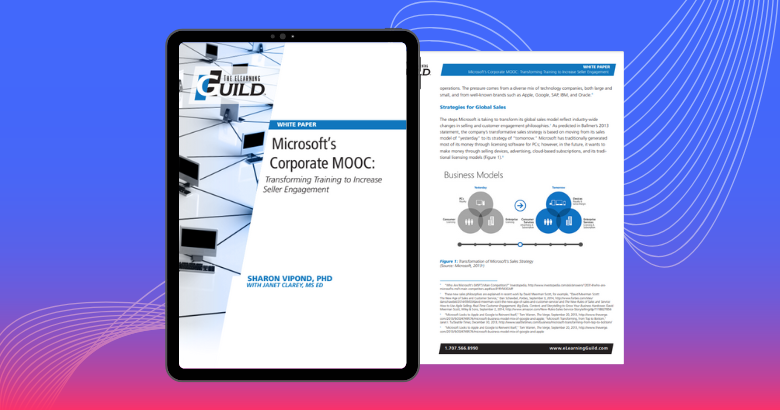
Microsoft’s Corporate MOOC: Transforming Training to Increase Seller Engagement
This paper explores Microsoft’s first massive open online course (MOOC), examining lessons learned from the design and implementation process and how Microsoft L&D leaders plan to move forward.
-

Mentored Tasks: Support Learners Where They Are
Supporting today’s agile organization with training solutions alone is difficult. And while instructor-led training, eLearning, and blended solutions will continue to be important parts of the L&D toolkit, we also need solutions that address pressing matters and move at the same speed our businesses move. Mentored tasks may be exactly the performance support solution you have been looking for.
-

Nuts and Bolts: Causing Serendipity
The story of the three princes of Serendip is more than an entertaining fable. It illustrates the limits of formal training, and the value of being able to learn something valuable from information that just came your way. You may not be looking for a lame, one-eyed camel that is missing a tooth and carrying an unusual cargo, but you might also learn something valuable from this column.
-

Adventures in the xAPI: The Stroke Ready App
The University of Michigan Health System’s Stroke Center team wanted a way to educate the public to recognize symptoms of a stroke and to get potential stroke victims to the emergency department quickly. A combination of the xAPI and tablets is providing a solution that they are now testing. Read about the Stroke Ready App in this spotlight!
-

Adventures in the xAPI: The Ann Arbor Hands-on Museum Project
The Experience API (xAPI), in connection with RFID tags or beacons, makes it possible to assess learning interactions that go beyond what SCORM can do. This is the first of several articles that will provide specific real-life examples of the kind of work that eLearning designers are doing today with the xAPI.
-

Riding the Digital Stream: Integrating Modern Learning Practice into Formal Programs
As we break away from discrete training efforts and move toward joining formal-personal and social-informal learning together in one continuous, systematic program, what are the steps and practices that will make that process smoother? How can we help people learn to function at a high level without the need for formal training? Here’s a thought-provoking look at some answers.
-

Brain Science: Can Training Change Your Corporate Culture?
Some scandalous questions: What are the odds that your eLearning, by itself, will succeed at changing behavior? Put another way, “Does education matter?” Will teaching people new information really get them to behave in new ways? Art reveals some research that lay hidden for years, although it opens insights into what does and does not cause groups of people to change their behavior.
-

Six Tips for Front-line Leadership Development
Companies are planning to spend more on training for front-line managers, but will this create better results? The challenge is getting what’s taught in the classroom and in eLearning to transfer to the job. This seems daunting, but physical therapists (PTs) routinely get this transfer to happen. Here are six tips, ideas from research and from the masters of misery, your friendly local PTs.
-

Enhance Your Corporate Classroom’s Learning Ecosystem
As you consider your learning and performance ecosystem, remember to include your physical spaces: meeting rooms and classrooms. In many cases, these rooms have limited technology to optimize learning and communication, although digital presentation solutions have been available for some time. This article presents some options that can result in deeper learning when properly used.