
When a military mantalks about disruption in any context it is a good idea to listen! Meet Garry Hearn, until recently the man in charge of designingand organizing learning strategy for British military units covering 44,000 servicepersonnel. Garry was decorated by Queen Elizabeth II for his services toMilitary Education and Leadership. Now in “street civvies” with Cuerden Consulting, and in demand as a conference speaker, Garry workswith futurist Jason Burrows, to bring new thinking to the “disruption”they see happening in the traditional learning space.

Garry Hearn
About disruption
What does Garry meanby “disruption”? “There is a power switch on the horizon. We see the growth ofthe shared economy and the meteoric rise of companies like Uber. Then there is WhatsApp valued in 2014 at $19B with just 55 employeesand contrast that with Morrisons (UK supermarket chain) with 56,000 employeesbut only valued at $12B. Forty-one percent of Americans now have multipleincome streams—they have portfolio careers. Millennials will become themajority of the Western workforce around 2020—and already are in many emergenteconomies with lower-age demographics.”
Does this matter? Whatimpact does it have? Garry: “Millennials are interested in quick responses totheir learning needs, are tech savvy, and want to see a connection betweentheir learning and their workplaces. It is a power shift towards theindividual.”
70:20:10 done wrong anddone right
Garry believes that,powerful as it is, 70:20:10 has been applied as a linear model “We reallyneed to see it as a mosaic—dots of appropriate 70:20:10 happening all throughan individual’s learning landscape. And that is not organizationally focusedbecause the individual is no longer wired like that. While most of our eLearningis currently focused on organizational needs, the modern worker wants a shiftto a space where they can make their portfolio marketable.”
It all needs freeingup. Garry describes it as, “A shift from eLearning to easy learning!” Yet muchthat is corporate is still set up to prevent that freedom.
Reid Hoffman (founder of LinkedIn) talks about innovationcoming from the short “tour” employees who simply transform things (seeHoffman’s 2014 book The Alliance).How do they develop? Many times they will leave one organization to gainknowledge and experience elsewhere, only to return eventually with added value,new ideas, and an extended network. Garry: “Hoffman sees that as a positivefeature of organizational DNA, welcoming it, using the fluidity to createallies and to extend the organization’s network.” That contrasts sharply withthe old paradigm of restraints of trade and the frequent viewing of “leavers”as traitors.
What is the influenceof these phenomena on a military man’s thinking? “In the British Army I recognizedthat cost was outstripping quality. Agility was being held back by rigidprograms and delivery means. So we introduced a whole string of ideas—self-directedeLearning, VLE’s, flipped classrooms—we saw a direct impact on pass rates attraining schools. The cost profile went down, reach and speed of reachincreased, quality rose.” Proof indeed that the blended approach works!
Embrace complexity,ambiguity, and disruption
Garry uses militaryanalogies. “Former US General Stanley McChrystal talks about working with complexity and thefailures of applying linear processes in Iraq where Al Qaeda usedunpredictability to great effect, appearing, making impact, and disappearingonly to re-appear somewhere else. McChrystal nowurges the acceptance and enabling of complexity.” The analogy with the changedwork place is clear. Technology has a massive role—so another analogy: “ISIS hasrecruited 25,000 people from a worldwide social network at a minimal cost ofmaking minimal home-made videos posted on a network that it does not own. Bycontrast, the UK National Audit Office reports the British Army’s £1.3B traditionallybased recruitment program was 67% under target in 2014 (adding just 3,600 to the reserve).”
Garry asserts, “Complexity is here. At the moment, we allow it todisrupt ourselves. We need to throw away that doctrine and adopt newmethodologies.” Hearn and Burrows have developed a new “7A’s” model (Figure 1) theybelieve will help organizations understand, adapt, and thrive.
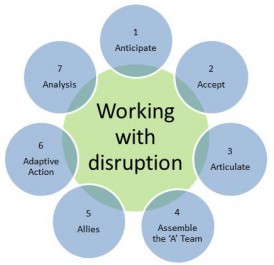
Figure1: The 7A’s model
(CopyrightBurrows Advisory Limited; used with permission)
That’s some insightfrom a military viewpoint—Garry goes further…
“I realized it isabout inverting the organizational pyramid. It is about learning to serve inorder to be an effective leader. It is no coincidence the renowned SandhurstOfficer Training College has ‘Serve to Lead’ as its motto!”
The problem is ourcorporate personas do not like that kind of disruption and are slow to react toit—but the warnings are clear!
Garry reflects on itall in Learning to Lead: From Bombs and Benefits to Buckingham Palace (2015).